


Adjustable Nickel Cup Hinge With Hydraulic Damper F870
F870 Adjustable Cup Hinge With A Knurled Collar, A Piston In The Arm And A Slotted Mounting Plate

F870 is a concealed cabinet hinge finished in bright nickel. Read from the photographs, it is made of three parts: a round cup with a flat flange and two fixing holes that disappears into a boring in the door, an arm that carries the knuckle joint, the adjustment collar and the damped piston, and a mounting plate that screws to the inside of the carcass. The whole fitting is the same silver white colour, so this listing does not describe a contrast between a coloured cup and a bright arm the way some of our other cup hinges do.
The arm is where the working parts are. Two crosshead screws sit either side of a black rectangular window, and in the frames taken from the open side a bright cylindrical rod is visible inside the arm with a black block at its end. That rod is the hydraulic element, and it is the reason this hinge closes under control instead of swinging free. The knuckle itself is built from stacked segments, and between the cup and the arm there is a knurled ribbed collar which is the visible adjustment feature of the model.
What The Photographs In This Listing Do And Do Not Prove
Six frames are used for this listing and every statement above comes out of them. What is visible is the fitting itself: the shape of the cup, the number and type of fixing holes, the collar, the piston, the screws and the plate pattern. What is not visible is any measurement, so this page carries no boring diameter, no overlay figure, no opening angle, no load rating and no cycle count. Those numbers belong to the hinge drawing and to the test report, and both are issued on request rather than guessed here, because a figure copied from a similar looking hinge is worse than no figure at all.
One further exclusion is worth stating, because it is the sort of thing a buyer only notices after the container arrives. The supply folder for this hinge also contained a photograph of the fitting standing on a digital weighing scale, and frames of that kind are not used in the listing. A display reading on a scale in a studio photograph is not a published specification: it is one sample on one instrument, and it is not the number a buyer should be quoting to their own customer.
How The Hinge Is Built

Splitting the hinge into its two halves in a photograph is the clearest way to show what a fitter is actually handling: the hinge body stays on the door and the plate stays on the case. In this model the plate is a flat stamped part with two large round holes and oblong slots, and the body carries the cup, the knurled collar, the damped arm and the closing end of the knuckle.
- Round bored cup in bright nickel with a flat flange and two fixing holes.
- Knurled ribbed collar between the cup and the arm, which is the visible adjustment point on this hinge.
- Arm with two crosshead screws either side of a black rectangular window.
- Bright cylindrical piston inside the arm with a black end block, visible in the frames taken from the open side.
- Stacked knuckle segments at the joint rather than a single long barrel.
- Mounting plate with large round holes and oblong slots for fixing and for alignment.
- Closed ribbed tail at the end of the arm rather than an open fork.
What Adjustable Means On This Particular Hinge
The folder this hinge was supplied in calls it an adjustable hydraulic hinge, and the photographs support that in three specific places rather than in general. The first is the knurled ribbed collar between the cup and the arm, which is the sort of feature that is meant to be turned by hand or by a tool rather than left alone. The second is the pair of crosshead screws in the arm, positioned either side of the damper window where an adjustment screw would normally act on the arm angle. The third is the oblong slots in the mounting plate, which let the whole hinge be moved along the case wall after the screws are home.
What the pictures cannot tell a buyer is how much movement each of those features gives, and in which directions. On hinges of this family the practical adjustment is normally a few millimetres at the plate plus whatever the collar allows at the arm, but a range quoted from memory is not something to bore a door production line against. Ask for the adjustment diagram with the drawing and you will get the figures for the hinge you are actually ordering, measured off the same tooling that makes it.

The third frame is useful precisely because it is taken from the inside. The knuckle segments, the ribbed band under the cup and the rod inside the arm are all in one view, so a buyer checking whether this hinge matches a drawing they already hold can compare the construction rather than the silhouette. Hinges that look identical from the finished side are often different in the knuckle and in what is housed in the arm.
Boring The Cup And Hanging The Door
A round cup hinge lives or dies by its boring. The cup drops into a flat bottomed hole in the door face, and it is the wall of that hole, not the screws, that resists the lever a door puts on a hinge every time it is opened. Cut the bore shallow and the cup sits high, which pulls the door off the case line and shows as a gap at the top. Cut it deep and the flange loses bearing surface. The correct diameter and depth for this hinge come from the boring drawing, which we send with the quotation, and a sample hinge sent ahead of a production order lets a workshop set its drill on its own board rather than on paper.
The board matters as much as the bore. Chipboard and MDF hold the two cup screws and the plate screws only as well as the pilot hole and the screw gauge allow, and a plate that has been taken on and off several times during fitting is the usual reason a door sags later. On soft board a hinge of this class is normally used with the recommended screws rather than a shorter driver, and where the case wall is thin the plate should be fixed into the rail rather than into the panel.
How Many Hinges A Door Needs
Hinge count follows door height and door mass, not preference. A tall door hung on two hinges lifts its upper fixing out of the board over a season, and the first symptom is never the hinge, it is the screw holes. On a cabinet of this class the practical rule we work to is two hinges up to a modest door height, three above that, and an extra hinge at mid height on a tall or heavy door so the middle of the rail is not carrying the twist. The actual break points depend on the door, so they are agreed against the drawing and the board thickness rather than assumed on a product page.
Where a door is fitted with a damped hinge on both leaves of a pair, buyers sometimes ask for the damper on one only. That is a legitimate choice in low traffic work and it saves a fitting per door, but it changes how the second door behaves, and it should be a decision made once at specification stage rather than discovered by an end user.
Where This Hinge Is The Right Call, And Where It Is Not
A nickel finished cup hinge with an adjustment collar and a damped arm belongs inside furniture: kitchen wall and base units, wardrobes and closets, bathroom vanity units that are used and wiped rather than hosed, office and hotel casework, and retail joinery assembled in a workshop and hung on site. It is a concealed hinge, so with the door shut only the plate is visible inside the case, which is what most furniture buyers are specifying when they ask for this family.
It is the wrong hinge for a marine locker, a hosing down area, a food processing room or an unventilated external cabinet in a coastal position. The finish here is a decorative interior finish rather than a marine barrier, and bright plating always has pinholes at the knuckle where salt and chlorine start. On a boat or in a wash down scullery we would move a buyer to a stainless hinge even though it costs more per fitting, because a hinge that corrodes through in one season costs more than the hinge ever did.
Specification Summary
| Model | F870 |
| Hinge type | Concealed bored cup hinge for cabinet and furniture doors |
| Cup | Round, bright nickel, flat flange, two fixing holes |
| Adjustment | Knurled ribbed collar between cup and arm, two arm screws, oblong slots in the plate; travel figures from the drawing |
| Closing action | Controlled closing with a hydraulic piston housed in the arm |
| Visible internals | Bright cylindrical piston with black end block, stacked knuckle segments, black rectangular window in the arm |
| Arm end | Closed ribbed tail |
| Mounting plate | Flat plate with large round holes and oblong slots |
| Finish | Bright nickel over steel |
| Door material | Panel materials that can be bored: chipboard, MDF, plywood, solid timber rails |
| Cup boring diameter and depth | From the boring drawing, issued on request |
| Opening angle, overlay and load | From the hinge drawing; not read from photographs |
| Fixing screws | Not supplied as standard unless agreed on the order |
| Sample policy | Samples before a production order so the hinge can be bored and hung in the buyer's own board |
How Each Hinge Batch Is Checked Before Packing
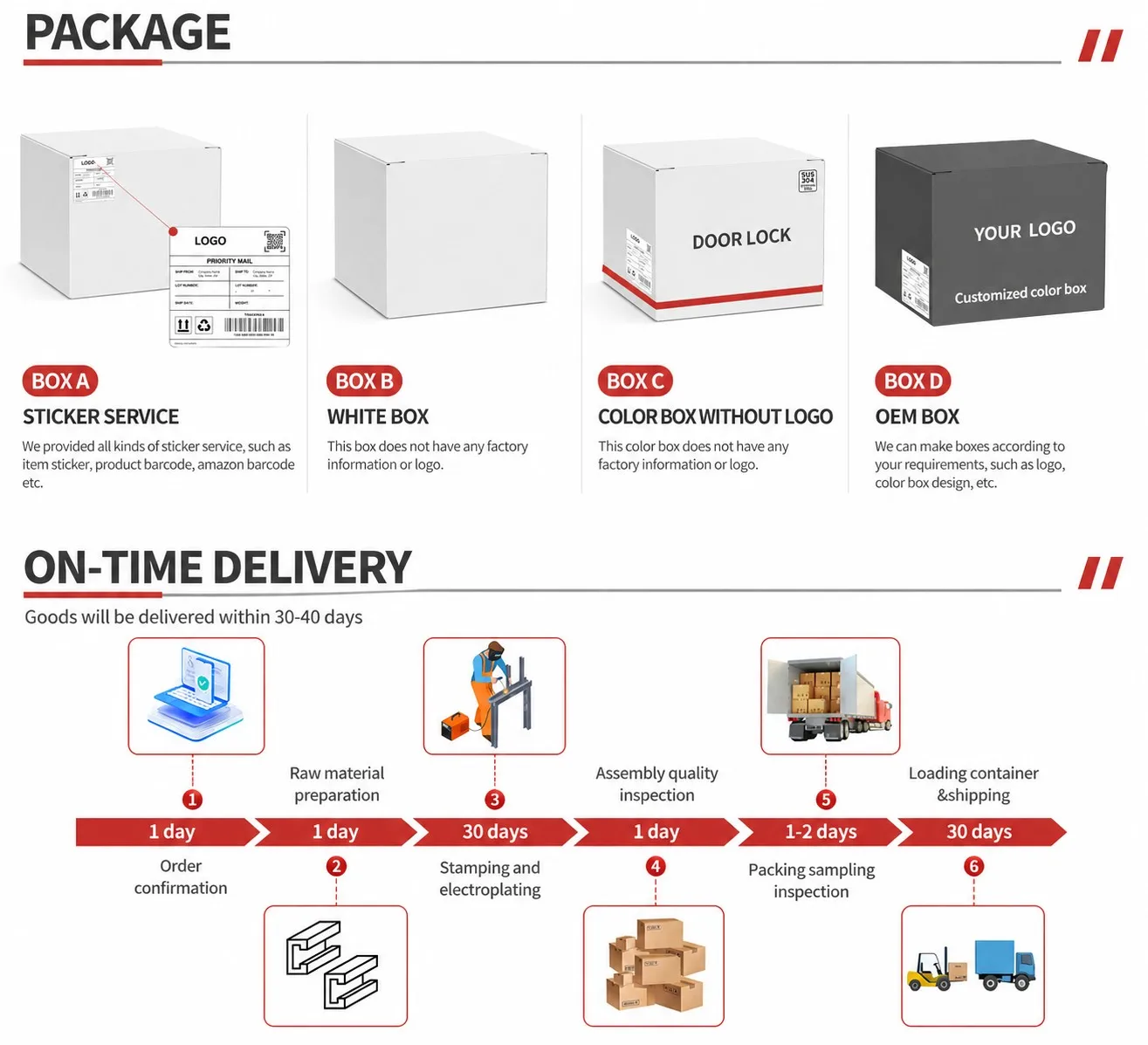
Every hinge batch is sampled on four points before packing. Function: the hinge is worked through its full swing by hand so an arm that damps unevenly, a knuckle that binds or a collar that has been assembled cross threaded shows up before the carton is closed. Appearance: the nickel surface is checked for passivation marks, handling scratches and any plating that has pulled at the cup flange radius. Assembly: the two cup screws, the arm screws and the plate holes are checked to be present, driven and unstripped. Packing: carton quantity, inner bag, marking and the model number on the label are checked against the order rather than against the previous job. Test reports and the documents a buyer needs at their own customs are issued on request, and the specification written on the proforma is the specification that is produced.
Who Supplies This Hinge
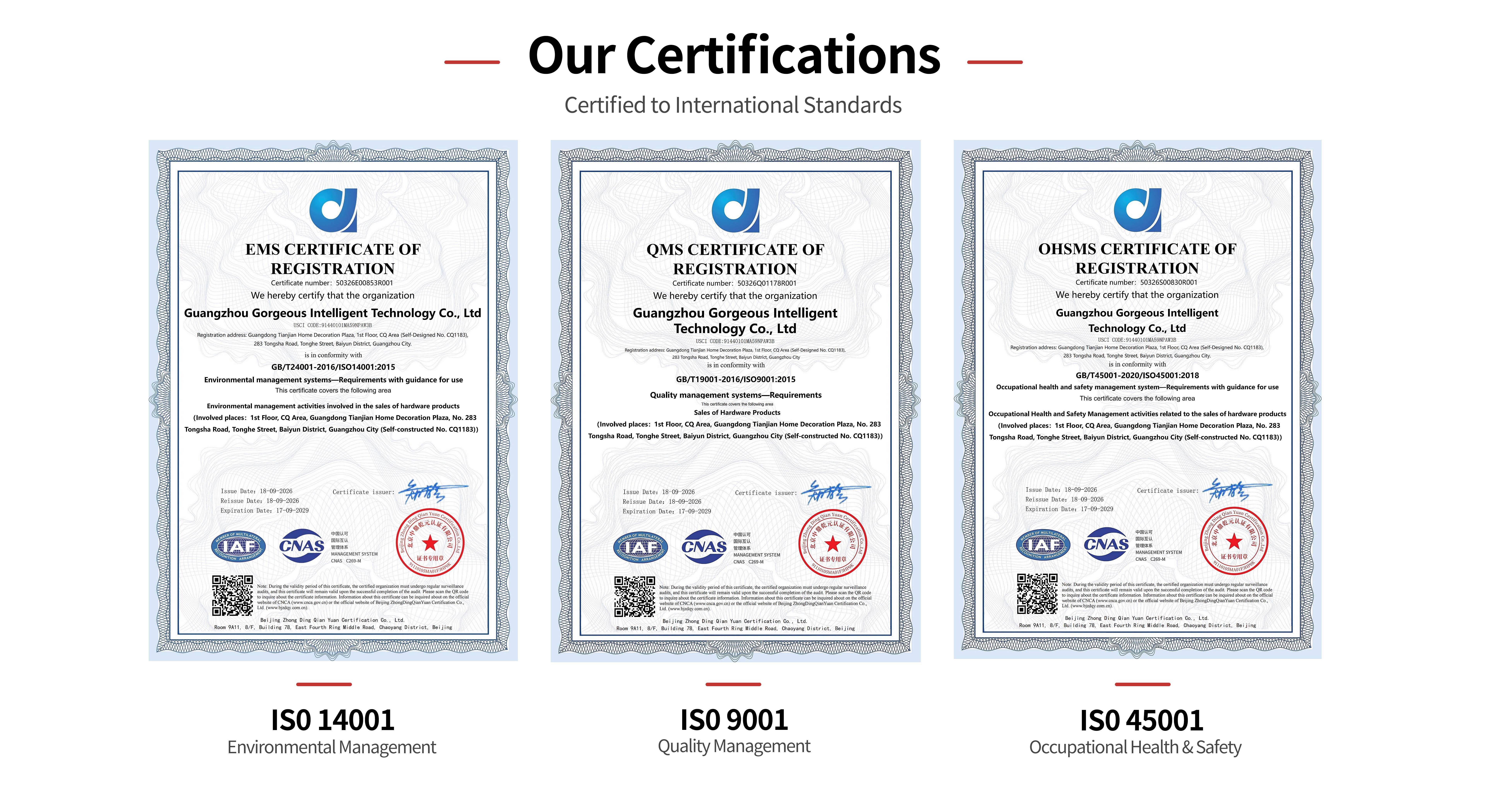
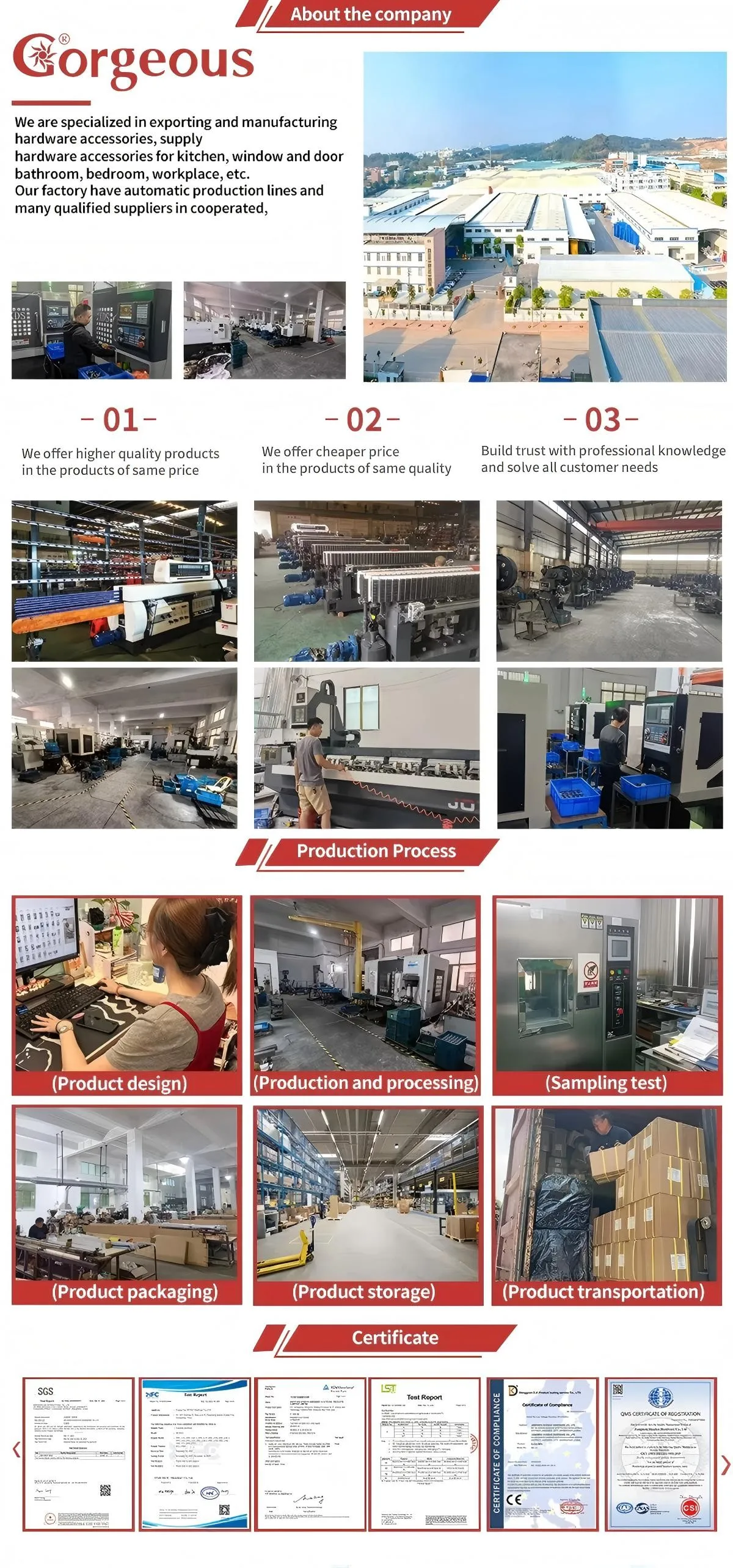
This hinge is supplied by Guangzhou Gorgeous Intelligent Technology Co., Ltd., a furniture and architectural hardware business whose range covers hinges, drawer slides, handles, stays, legs, castors, locks and the fitting sets that go with them. The company works to export orders: quantities, carton marking, barcodes and shipping documents are agreed before production rather than after it, and a buyer who specifies the adjustment detail, the plate variant and the screw type on the order gets those things made, because that is the only specification the factory will work from.

Terms Worth Agreeing Before Two Hinges Are Compared
- Cup hinge: a hinge whose door half is a round cup sunk into a boring; this page sells a cup hinge, and the cup on this hinge is nickel.
- Arm: the part of the hinge between cup and plate; on this hinge the arm carries the damper, so a hinge with the same cup but another arm is another hinge.
- Plate: the half of the hinge fixed to the case; the slots in this hinge plate are what let a hung door be moved.
- Overlay: how far a closed door overlaps the case; two hinges can share a cup and still be different hinges because their arms hold the door at a different overlay.
- Damped hinge: a hinge that slows at the end of its swing; this hinge is damped by a piston, which is why the arm has a window in it.
- Lift off hinge: a hinge that separates without tools; this hinge has a closed tail, so it is not that kind of hinge.
- Fixing holes: the holes that carry the screws; on this hinge two sit in the cup flange and the rest sit in the plate.
- Drawing: the document that turns a hinge photograph into a hinge specification; without it a hinge cannot be bored, and we send it with the quotation.
Common Hinge Faults And What They Actually Mean
A door that drops over time is almost always a fixing problem rather than a hinge problem. The hinge is the strongest part of that joint; the board it is screwed into is not. In chipboard and MDF the holding power depends on the pilot hole and the screw gauge, and a plate that has been screwed and unscrewed repeatedly while a fitter chases the line loses grip, which shows up later as the plate pulling away from the carcass while the hinge itself is still sound.
A hinge that stops closing slowly has usually been worked past its duty: either the door is heavier than the hinge count assumes, or the door has been pulled to by hand against the piston. The piston in an arm like this one is a hydraulic restriction rather than a brake, and repeated manual overrunning is what empties it. A hinge that feels loose at the knuckle after a season is normally carrying a door that is heavier than the hinge count assumes, and the answer is another hinge rather than a tighter screw.
A door that will not close flush after fitting is nearly always an overlay or plate choice rather than a defective hinge. This is the point of the slots in the plate and of the collar on the arm: they exist so the fitter can correct the door after the screws are home. If the correction needed is larger than those slots allow, the hinge variant is wrong for that case, and the plate variant should be changed rather than the door being forced.
How This Hinge Compares With The Other Cup Hinges We Supply
Within our own cup hinge range a buyer usually chooses between three arm treatments, and F870 sits in the middle of them. An undamped hinge closes at whatever speed the door arrives at, which is fine for low traffic joinery and is the cheapest option per fitting. A hinge with a coil spring returns the door positively but does not slow it, so it is chosen where the door has to be shut by the fitting rather than by the user. A damped hinge of the kind shown here slows the last part of the swing and stops, which is what a kitchen or wardrobe purchaser is normally asking for when they say soft close. This hinge carries the piston rather than a visible coil spring, which is consistent with the photographs: the arm shows a rod and a window, and no coil appears in any frame.
The second choice is the tail. An open fork tail lets a hinge be lifted off its plate by hand, which is convenient on site and exposes the internal parts. The closed ribbed tail on this hinge keeps the piston and the linkage inside the body, which is the better trade where the hinge will be worked thousands of times and no one wants to re-hang a door to clean behind it.
Questions Buyers Ask About This Hinge
- Is F870 a soft close hinge? The arm houses a bright cylindrical piston with a black end block, visible in the frames taken from the open side, and closing is controlled by that piston. The damping figure itself is a test number and comes from the report we issue on request rather than from the photograph.
- Is there a spring in this hinge? No coil spring is visible in any of the six frames used in this listing, so we do not describe one. The visible working parts are the piston in the arm and the knurled collar between the cup and the arm.
- What exactly is adjustable? Three features are visible: the knurled ribbed collar, the two crosshead screws in the arm and the oblong slots in the mounting plate. The travel each one gives is on the adjustment diagram, which we send with the drawing.
- Does the plate lift off? The tail on this hinge is closed rather than an open fork, so it is not a lift off design. The door comes off by undoing the screws, and that should be assumed when planning the installation sequence.
- Can this hinge be used on a glass door? Nothing in these photographs is a glass clamp. The part that meets the door is a bored round cup with a flange and two fixing holes, so this listing is for panel doors. If a glass application is being considered, ask for the drawing and we will confirm what the fitting can and cannot do.
- Which finish is this? A bright nickel coloured finish over steel, the same colour on the cup, arm and plate. It is an interior finish; for wet, hosed or coastal work we quote stainless instead.
- Can we order the plate with a different hole pattern? Hinges of this family are supplied with more than one plate, and plate variants can be agreed on the order. Send the case material and the fixing method and we will confirm which plate suits it before production.
Sign-Off Checklist Before You Order This Hinge
- Door material confirmed as a panel material that can be bored for a round cup.
- Door height and mass confirmed against the hinge count, with an added hinge at mid height on tall doors.
- Cup boring diameter and depth taken from the drawing for this hinge, not from a previous hinge.
- Adjustment travel confirmed from the diagram rather than from the presence of a collar.
- Plate variant confirmed against the case material and the fixing method.
- Overlay requirement confirmed so the correct plate is ordered for the door gap.
- Screw specification agreed separately, since fixings are not supplied as standard.
- Environment confirmed as dry or moderately humid; wet, hosed and coastal work is outside this finish.
- Closing behaviour confirmed as damped rather than sprung, matching the piston shown in the photographs.
- Packing, carton quantity and marking confirmed against the order before the hinge batch starts.
Ordering
Send the model number F870 with the quantity, the destination port and the carton marking you need. Samples are available before a production order so the hinge can be bored and hung in your own board, which is the fastest way for both sides to agree that the boring, the adjustment and the closing behaviour are right. The drawing, the boring dimension sheet and whatever test documentation we hold for this hinge model are issued on request, and delivery and payment terms are agreed order by order on the proforma rather than assumed from a previous order.


Comprehensive score