


Black Plastic Detent Stop Hinge 80/115/150 G-K437
The G-K437 Black Plastic Detent Stop Hinge In Six Photographed Positions

This listing is written from the frames in this folder, and six of the eight are used on this page. What they show is a black plastic detent stop hinge: a hinge that folds like any other hinge but stops at a set angle instead of swinging freely. The hero frame is the hinge closed and turned at an angle, two rounded mounting wings either side of a ribbed barrel. The technical drawing is the frame a buyer specifies from, and it carries the whole specification on one sheet. Three further frames show the hinge working: open with its four countersunk holes and the loose snap-on cover caps beside it, drawn in its three stop positions at 80, 115 and 150 degrees with the stop angle defined on the frame, and turned over to show the coil springs and the detent plate inside the barrel. One frame shows the same hinge in black beside the same hinge in white, which is the colour pair this hinge is made in.
A detent hinge is a particular kind of hinge and it is worth being precise about the difference at the start, because a buyer who needs a free swinging hinge and a buyer who needs a hinge that holds are two different buyers. A plain hinge lets a door or a panel fall to wherever gravity takes it; that is correct in some furniture and wrong in others. The hinge on this page has springs inside its barrel pressing a detent plate against the wing, so the hinge travels freely up to the angle the detent is cut for and then holds there. The hinge on a showcase, a display cabinet or an access panel that has to stay open while both hands are busy is this hinge, and the whole value of it is that the hinge holds the panel rather than the panel falling on the hinge.
The Specification The Drawing States

The drawing is the frame a buyer reads the hinge from, and it states the hinge completely. Across the body the hinge is marked 59 millimetres, and the barrel that carries the detent is marked 34 millimetres wide. The mounting pattern is four 5.2 millimetre screw holes, one in each corner of the two wings, and four 12 millimetre recesses beside them, which are the seats the cover caps snap into. In depth the hinge is marked 51 millimetres, with a 21 millimetre body depth under the barrel, and the height stack over the barrel is marked 20, 10.5, 8 and 2 millimetres. The note under the drawing reads Model G-K437, Weight 37 grams and Surface treatment Black plastic, and the drawing also carries the three stop angles the hinge is made in.
| Hinge figure | Marked on the drawing |
| Overall footprint | 59mm by 51mm |
| Barrel width | 34mm |
| Screw holes | 4 x 5.2mm, one per wing corner |
| Cover cap recesses | 4 x 12mm |
| Body depth under the barrel | 21mm |
| Height stack over the barrel | 20 / 10.5 / 8 / 2mm |
| Weight | 37 grams per hinge |
| Stop angles | 80 degrees, 115 degrees, 150 degrees |
| Surface treatment | Black plastic, also supplied in white |
Two figures on the drawing are the ones a buyer is most likely to leave out of a build, and both are the sort of figure that only shows up when the panel is already drilled. The first is the 21 millimetre body depth under the barrel: the wings are thin but the barrel is not, so a hinge of this kind needs clearance behind the barrel rather than behind the wings, and a panel that is only as thick as the wing will not take the hinge. The second is the height stack, 20 millimetres at the top of the barrel against 8 millimetres at the wing face, which is what the hinge stands off the panel by. A detent hinge that is chosen on its footprint alone and then found to stand 20 millimetres proud is a hinge that has to be returned, so the footprint and the stack are stated together here and both come off the drawing rather than off a photograph.
The Three Stop Angles
The stop angle is the figure that decides which version of this hinge a buyer orders, and the frame draws all three. A hinge cut to stop at 80 degrees holds a panel just short of square, which is the angle for a cabinet door that has to stay clear of a wall or of a neighbouring door. A hinge cut to stop at 115 degrees holds a panel a little past square, which is the angle for a showcase door that has to stand open far enough for a hand to reach past it. A hinge cut to stop at 150 degrees holds a panel well past square, which is the angle for a display or an access panel that has to open almost flat against its own face. The frame states the definition beside the drawing, the angle at which a moving blade is controlled to stop during its rotation, and that definition is the whole function of the hinge in one line.
Three angles is a range rather than a set of variants for their own sake, and a buyer who is unsure which hinge to take can work it from the job rather than from the catalogue. If the panel must not swing past the frame it hangs on, the smallest stop angle is the safe hinge; if the panel must open wide enough to clear a shelf or a light fitting inside the cabinet, the middle angle is the hinge; if the panel must open until it lies against the adjacent face, the largest is the hinge. What a stop angle hinge cannot do is be adjusted after the fact: the angle is cut into the detent, so the hinge is ordered at the angle the job needs rather than set at the bench. That is worth saying plainly because it is the one thing a buyer cannot fix later on a hinge of this kind.
The Springs And The Detent Inside The Barrel
The underside frame is the frame that explains how a plastic hinge holds an angle, and it is the frame worth reading before doubting the hinge. Inside the barrel there is a pack of coil springs sitting against a detent plate, and the plate is what the wing rides against as the hinge turns. When the hinge reaches the angle the detent is cut for, the spring pressure seats the plate into its notch and the hinge stops there; when the panel is pulled past that angle the plate rides back out against the springs. That is the whole mechanism of a detent hinge, and what the frame proves is that this hinge carries real springs rather than relying on a moulded bump to do the work. A moulded bump loses its hold as the plastic wears; a spring pack keeps pressing against the plate for the life of the hinge.

The underside frame also shows the marks moulded into the hinge, a Y and a 1, and the ribs and screw bosses that carry the load from the four screws into the barrel. Those bosses matter on a plastic hinge of this size: the wings are thin, the barrel is 20 millimetres high at its top, and the load of a door that is pulled against a detent arrives at the screw bosses rather than at the wing face. A boss that is properly thickened spreads that load into the hinge body, and the frames carry the supplier's own statement that this hinge is moulded from new material to national standards rather than from regrind. On a hinge that is expected to hold an angle for years, the material is the specification and not a marketing line.
The Cover Caps And The Finish
The frame that shows the hinge open is the frame that explains the four 12 millimetre recesses on the drawing. The four 5.2 millimetre holes take the screws, and the four larger recesses beside them take snap-on cover caps, which is why the frame shows two loose cover plates laid out on either side of the hinge. The cap is not decoration on a hinge of this kind. A screw head on a black plastic hinge is a bright metal dot on a black surface, it is where a cloth catches, and on a panel that is cleaned often it is where corrosion starts; a cap that snaps over the head leaves the hinge face smooth and flush and leaves the fixing protected. The same frame that shows the caps also carries the supplier's claim that the material is moisture-proof and corrosion resistant, and a cap over every screw is part of how that claim is delivered.
The finish pair is on the frame that shows a black hinge beside a white one, and it is worth a line because colour is an ordering decision on this hinge rather than an afterthought. The drawing states the surface treatment as Black plastic, and the same hinge is made in white for panels where a black dot would be wrong. A white hinge on a white laminate panel and a black hinge on a black panel are both invisible at a glance, which is the point of offering the pair; a buyer mixing the two on one run is a buyer who should say so on the order, because the caps, the wings and the barrel are all the same colour on a hinge of this kind and a mismatched cap shows. The frames show both colours moulded in the same shape with the same ribbing, so the choice is finish only and the hinge is the same hinge.
What The Frames In This Listing Prove
Every structural claim on this page can be pointed at in one of the frames. The shape of the hinge, its ribbed barrel and its two rounded wings are in the hero frame. The footprint, the barrel width, the screw holes, the cap recesses, the body depth, the height stack, the weight, the surface treatment and the three stop angles are all on the technical drawing. The open hinge, its four countersunk holes and the loose cover caps are in the frame that shows the hinge open. The three stop positions and the definition of a stop angle are in the frame that draws them out. The black and white pair is in the colour frame. The springs and the detent plate, the ribs, the bosses and the moulded marks are in the underside frame. What no frame on this page proves is the force the detent holds with, the number of cycles the hinge runs before the hold changes, the impact strength of the moulding and the exact resin grade, and none of those figures is carried here as a photograph fact. They come from the hinge drawing and the test report for this model, and a figure borrowed from a similar looking hinge is the kind of typo that shows up when a showcase door will not stay open.
Two things are stated as class behaviour rather than as frame facts. The detent hold is the first: the frames show the springs and the plate, not the hinge holding a door, so the holding force and the pull needed to pass the detent are drawing figures and are confirmed on a sample before a production order is cut. The fit of the cover caps is the second: the frames show the caps loose and the caps fitted, not the caps after a hundred removals, so the retention is checked on a sample by fitting and lifting a cap repeatedly. Both checks are what a trade buyer does anyway before committing to a container, and neither is answerable from a photograph.
The staged set also omits, on purpose, the two source frames that repeat what is already on the page. One is a pair of text panels about thickened material and surface treatment, whose claims are carried in the copy above and whose product detail is already covered by the hinge close ups. The other is a set of three folded views of the closed hinge, whose poses are already carried by the hero frame and by the stop angle frame. Nothing in either of them is a view the six staged frames do not already carry, so they are described here rather than used twice on the page.
How The Hinge Is Built
Read the drawing and the underside frame together and the hinge is plain to follow. The body is a single moulding in black plastic, wings, barrel, ribs and screw bosses all in one piece, so there is no joint in the hinge where a wing could work loose from a barrel. The detent plate and the spring pack are the only separate parts, and they sit inside the barrel where the wing closes over them. The cover caps are separate parts that snap into the four 12 millimetre recesses. The finish is the colour of the moulding itself rather than a coating, which is why a black hinge stays black where a painted one would wear through at the screw heads, and the supplier's own panels on this hinge claim new material to national standards, a thickened wall and a detail finish that is smooth without burrs.
- Detent stop hinge in black plastic, with the same hinge supplied in white for pale panels.
- 59mm by 51mm footprint, 34mm barrel, 37 grams per hinge as the drawing states.
- Four 5.2mm countersunk screw holes, one in each wing corner, and four 12mm snap-on cover cap recesses.
- Body depth 21mm under the barrel and a height stack of 20 / 10.5 / 8 / 2mm over it.
- Three stop angles: 80 degrees, 115 degrees and 150 degrees, cut into the detent rather than adjustable.
- Spring pack and detent plate inside the barrel, shown in the underside frame, holding the hinge at its angle.
- Single-piece moulding with ribs and thickened screw bosses carrying the load from the screws into the barrel.
- Snap-on cover caps over the screw heads, so the hinge face is smooth and the fixing is protected.
- Moulded from new material to national standards, with a detail finish the supplier states as smooth without burrs.
Where A Detent Hinge Earns Its Keep
A hinge that stops at a set angle is bought for three kinds of job, and the three are worth naming because they are the three the product keywords on this page name. As a detent hinge it goes on a showcase or a display cabinet where the door has to stand open at a fixed angle so a customer can see in and reach in without the door swinging back. As a position control hinge it goes on an enclosure, a machine cover, an access panel or a test rig lid, where the panel has to be held open while both hands are working inside. As a stop hinge it goes on a cabinet door that must not swing into a wall, a neighbouring door or a light fitting, and on any panel where the angle of opening is a safety line rather than a preference. The same hinge serves all three because all three need the panel held at an angle the hardware decides rather than the panel decides.
The plastic body is the other half of why this hinge is bought, and it is worth stating because it is not a compromise on this product. A black plastic hinge does not corrode, does not need plating, does not scratch a panel with a burr and does not conduct, which is why the same hinge is specified for bathroom and wet-area panels, for marine and outdoor cabinets and for electrical enclosures. The frames carry the supplier's own claim of moisture-proof and corrosion-resistant material, and the plastic body is what makes that claim possible on a hinge that otherwise would be zinc or stainless. A buyer who needs a stop hinge in a damp position and a buyer who needs one on a dry showcase are buying the same hinge in this case, and the black or white choice is the only finish decision left.
What To Confirm Before The Order Is Cut
Four figures are worth confirming against the drawing before a production order, and none of them is a photograph fact. The stop angle is the first, because the angle is cut into the detent and cannot be changed later, so the hinge is ordered at 80, 115 or 150 degrees and the order has to say which. The holding force and the pull needed to pass the detent are the second, because a showcase door and a machine cover ask different things of the same hinge. The panel thickness and the 21 millimetre body depth are the third, because the barrel needs clearance behind it that the wings do not. The colour and the cap retention are the fourth, because a black hinge on a white panel shows and a cap that lifts after repeated cleaning is a complaint rather than a fault.
Two checks are worth doing on the sample rather than on paper. The hold is the first: with the hinge on the buyer's own panel, the door should reach the stop angle and stay there with the panel's own weight against it, and it should pass the detent with a deliberate pull rather than a nudge. The caps are the second: every cap should seat flush with the hinge face on the first push and should survive being lifted and refitted, because a cap that stands proud is a cap that catches a cloth. Both checks take a few minutes and neither is answerable from a photograph.
- Stop angle named on the order, 80, 115 or 150 degrees, since the detent is cut and cannot be reset later.
- Holding force and detent pull confirmed against the drawing rather than assumed from a similar hinge.
- Panel thickness and the 21mm body depth checked together, because the barrel needs clearance the wings do not.
- Colour confirmed as black or white, with the caps matched to the hinge body on the same order.
- Hold checked on the sample with the buyer's own panel, the door reaching the stop angle and staying there under its own weight.
- Detent pull checked on the sample, passing with a deliberate pull rather than a nudge.
- Cover caps checked for a flush seat and for retention through repeated lifting and refitting.
- Screw specification agreed with the order, matching the four 5.2mm holes the drawing marks.
- Packing and carton marking agreed for a mixed order, so the angles and colours arrive as separate, labelled groups.
Questions A Hinge Buyer Asks
A hinge of this kind is bought on a handful of questions rather than on a paragraph, so the hinge is answered question by question here, and each answer points at the hinge frame or the hinge drawing it comes from.
- What does a detent hinge do? The hinge folds like any hinge but a spring detent inside the barrel holds the hinge at a set angle, so the panel stays where the hinge puts it instead of falling.
- Which stop angle do I need? 80 degrees for a door that must stay clear of what is beside it, 115 for a showcase door opened past square, and 150 for a panel that opens almost flat.
- Can the angle be adjusted later? No. The angle is cut into the detent of the hinge, so the hinge is ordered at the angle the job needs rather than set at the bench.
- Is this hinge metal or plastic? The hinge is a black plastic moulding, also supplied in white, and the drawing states the surface treatment of the hinge as Black plastic.
- Will the hinge corrode? A plastic hinge does not corrode or need plating, and the supplier states the hinge material as moisture-proof and corrosion resistant.
- How is the hinge fixed? Four 5.2 millimetre countersunk screw holes, one in each corner of the two wings, with a 12 millimetre recess beside each hole for a snap-on cap.
- Do the caps come with the hinge? The frame shows the loose cover caps beside the hinge, so the caps belong to the hinge, and the cap count for an order is agreed with the order.
- How deep does the hinge go? The wings are thin but the barrel stands 21 millimetres deep, so the clearance the hinge needs is behind the barrel rather than behind the wings.
- How heavy is the hinge? The drawing states 37 grams for the hinge, which matters on a light panel where a heavy hinge would pull the door off its line.
- Where is this hinge used? Showcases, display cabinets, enclosures, machine covers, access panels and any cabinet door where the opening angle of the hinge is a fixed requirement.
Who Supplies This Hinge
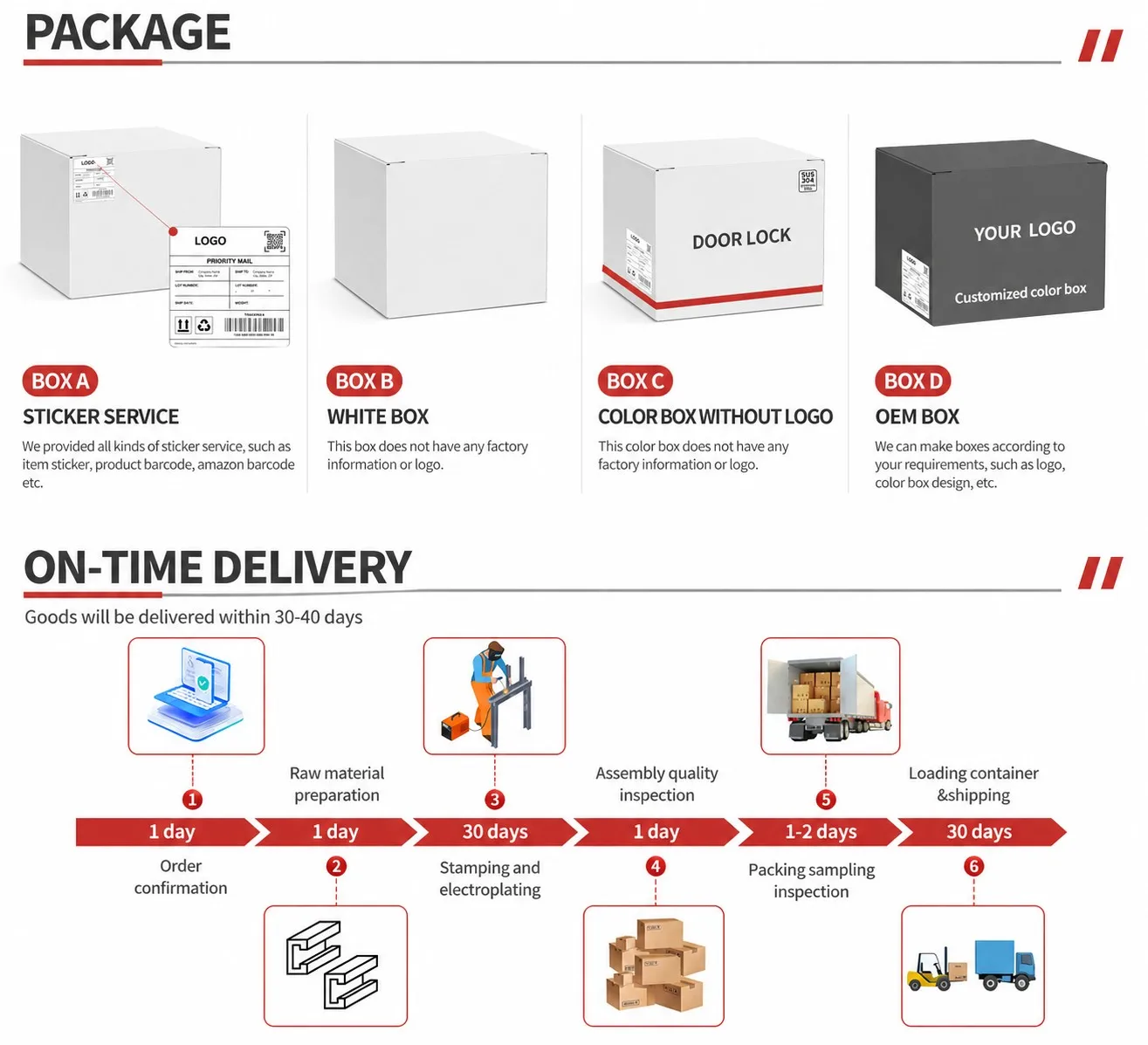
This hinge is supplied by Guangzhou Gorgeous Intelligent Technology Co., Ltd., a furniture and architectural hardware business whose range covers hinges, drawer slides, handles, stays, legs, castors, locks and the connecting and fixing plates that go with them. The company works to export orders: quantities, carton marking, barcodes and shipping documents are agreed before production rather than after it, and a buyer who specifies the stop angle, the colour and the screw specification on the order gets those things made, because that is the only specification the factory works from.




Ordering
Send the model number G-K437 with the stop angle or angles you need and the count for each, the colour, the destination port and the carton marking you want, and confirm the panel thickness and the detent figures against the drawing at the same time. Samples are available before a production order so the hinge can be fitted to your own panel, the door taken to its stop angle and the detent passed and re-seated, which is the fastest way for both sides to agree that the hinge holds where the job needs it and that the caps seat flush. The hinge drawing, the fixing sheet and whatever test documentation we hold for G-K437 are issued on request, and delivery and payment terms are agreed order by order on the proforma rather than assumed from a previous order.


Comprehensive score