


Corner Cabinet Hinge Kit Damped Pivot G-K434
The G-K434 Corner Cabinet Hinge Set In Six Photographed Positions

Six frames are used on this page and the first one is the hinge set as it arrives: two black hinge units, four bright corner brackets and a screw pack, laid out on a white ground. That is the right place to start, because this is a kit rather than a single part and the kit is what decides whether it fits a cabinet. The two hinges carry the door; the four brackets are what the hinge bodies land on inside the corner; the screws are what hold both. A buyer who orders one set is ordering a complete corner, not a loose hinge.
The folder behind this page holds nineteen views of the hinge pair and twenty-three of the bracket set, exported twice, once square and once slightly taller. The second export is the same camera positions as the first, not a second shoot, so the two folders together carry forty-two real views rather than eighty-four files. The six on this page were chosen because between them they show the whole kit, the inside of one hinge unit, the brackets on their own, and the way the set goes into a corner.
Two Hinges, Four Brackets And A Screw Pack
| In the set | What the frames show |
| Hinge units | two, mirrored left and right, black finish |
| Hinge body | closed box with a rounded end lug and a fixing hole at either end, riveted at the corners |
| Hinge arm | bright zinc plated steel rising out of the body, with an oval adjustment slot |
| Hinge link | forked link on a rivet pivot at the end of the arm |
| Pivot bracket | small two hole plate carried on the link, held by a cross head screw |
| Corner brackets | four, L shaped, bright zinc finish, die cast rather than bent strip |
| Bracket detail | recessed pocket down each leg with stepped fixing bosses in it |
| Fixings | screw pack, shown with the set in the first frame |
| Action | damped closing, which is what the model number names |
| Marked sizes | none in this batch; figures come on the drawing issued with the quotation |
The count of the hinge kit is the first thing to check against a job, because a corner cabinet does not take one hinge and does not take one bracket. Two hinges are the minimum for a door that pivots on a vertical axis: one at the top edge and one at the bottom, so the door cannot twist away from the cabinet. Four brackets follow from that, two per hinge position, one each side of the corner. A tall door wants a second pair of hinges and a second set of four hinge brackets, which is why the set is sold as a unit rather than as single pieces: a corner with two hinges at the top and one bracket missing underneath is a corner that sags at one end.
The hinge screw pack in the first frame is worth a note of its own. The frames do not promise a screw count and this page does not either, because the screw that suits the job follows the panel thickness rather than the hinge. What the pack does show is that the hinge set is expected to go up as it arrives, with nothing else bought alongside except the door and the cabinet.
What One Hinge Unit Is Made Of

The second frame is the hinge pair squared to the camera and it is the frame to read the construction from. Each hinge unit is dominated by a flat black hinge body: a closed box with a rounded lug at either end and a fixing hole through each lug, and a rivet at each corner of the plate. Inside that hinge body sits the damping element, which is why the hinge body is closed rather than an open yoke. Rising out of the hinge body is a bright hinge arm, plated rather than painted, with an oval slot milled through it. At the end of the hinge arm a forked link carries the small pivot bracket, and a cross head screw pins the bracket to the link.
That is four hinge parts doing four jobs, and the split is deliberate. The black hinge body is the part that goes against the cabinet or the bracket and never moves after it is set, so it is the part that is painted and riveted closed. The bright hinge arm is the part that moves through its arc, so it is plated and left bare where it works. The oval slot is adjustment: the hinge arm can slide against its fixing before the screw is tightened, which is how the door is brought level and set to the gap you want. The forked link turns the straight motion of the arm into the swing of the door, and the pivot bracket is the only part that touches the door itself.
The hinge pair is mirrored, which the frames make plain: hold the second frame up to the third frame in the same folder and the two hinge units are handed opposites of each other. That matters when ordering a replacement hinge, because one hinge of this pattern cannot simply be flipped to serve the other end of the door. It also means the top and bottom of a door are not identical parts, and a set that arrives with two of the same hand is worth querying before anything is drilled.
Why The Corner Bracket Is Die Cast

The fifth frame in the hinge set shows the four brackets on their own and it is the frame that explains the price of this kit, because a bracket is not a bracket. These are castings. Each bracket leg carries a recessed pocket with bosses standing in it, and the inside of the corner is thick where the two legs meet. A bent strip bracket of the same outside shape would be a flat L of sheet with holes punched through it, and it would flex at the corner the first time a door is hung on it. A casting puts material exactly where the load arrives: at the corner, at the bosses, and in the ribs between them.
The bracket bosses are worth reading closely in that frame. They stand proud inside the pocket rather than sitting flush, so the screw head lands on the boss and the bracket face stands off the panel by the depth of the pocket. That is how a cast bracket is meant to be fixed: the pocket takes the screw head, the face of the bracket stays flat against the panel and the load goes into the casting rather than into the screw. In a corner cabinet there is very little room for error here, because the two legs of the bracket set the angle of the whole door, and a bracket that flexes at the corner shows up as a door that drops at its far edge.
The finish on the brackets is bright zinc rather than black. That is not a mixed set arriving in the box: the bracket is a different part doing a different job, and the plating is the finish that survives being screwed into a cabinet panel and never seen again. The hinges are black because they are the part a customer sees when the door is open, and the brackets are plated because they are the part that is hidden inside the corner. The frames show both finishes in the same shot, which is the clearest way to say the kit is meant to look like that.
How The Set Goes Into A Corner
How The Set Goes Into A Corner
The third frame is the hinge installation sequence and it answers the question a buyer asks before ordering: where does each part go. The panels show the order plainly. First the corner itself, with the two legs of the cabinet meeting. Then the brackets, fixed into the corner at the top and again at the bottom, one each side, so that every hinge position has a bracket under it. Then a hinge unit set onto its bracket, the hinge body landing on the bracket face and its pivot bracket reaching out to where the door will sit. Then the door, hung on the pivot brackets at the top and the bottom so that it swings on a vertical axis at the corner rather than on a hinge at the side.
Reading that sequence backwards is the check that saves a wasted afternoon. If the door is already drilled for a side hinge, this set is not the answer for it, because the whole kit is built around a door that pivots at the corner. If the corner has no room for a bracket behind the door, the set will not sit flat. If the two legs of the cabinet are not at the angle the brackets are cast to, the door will hang off the corner rather than into it. The frames show the set going into a clean square corner, and that is the shape it is meant for.
What the sequence also shows is that the hinge is adjustable in one direction only, along its own arm. The oval slot lets the arm slide before the screw is set, which takes up the difference between the door and the bracket. It does not adjust the door up and down or in and out, so those have to be right from the drilling. On a set of this pattern the two brackets at the top and the two at the bottom carry the whole door, and the arm slots are the fine setting rather than the main setting.
What Damped Means On A Hinge Like This
The model number names this as the damped version of the pivot hinge, and damping is the reason to choose it over the plain version of the same set. A corner door is a small door on a short arc, and without damping it arrives at the closed position hard: the corner amplifies the knock, and on a cabinet with glass or a thin panel that knock is what a customer hears. A damper takes the last part of the travel and slows it, so the door comes to rest instead of arriving.
Two things follow for the buyer. The first is that the damping acts on the way in, not on the way out: the frames and the model do not promise a soft open, and a hinge of this pattern still needs a hand to start it. The second is that the damped body is a closed box, which is what the second frame shows. That closed body is also why this set should not be confused with a plain pivot hinge of the same shape at a lower price: the plain version has an open yoke and no damper inside it, and the two are not interchangeable once the door is drilled.
The Names This Set Sells Under
A set like this is bought under several names and the three on this page are the ones with real search behind them. It is a corner cabinet hinge, because that is the hinge a joiner asks for when a corner door has dropped and the phrase a joiner types when a corner door has dropped. It is a corner door hinge, because the hinge carries the corner door, the one that wraps the two legs of the cabinet. It is a pivot hinge, because the hinge lets the door pivot on a vertical axis at the corner rather than swinging on a knuckle at the side; the Chinese trade name for the same thing translates as a top and bottom hinge, which describes the same arrangement from the other direction: one hinge at the top edge and one at the bottom edge, and the door turning between them.
It is worth saying what this set is not, because all three names are used loosely. It is not a concealed cabinet hinge with a cup and an arm: nothing about this hinge is hidden inside a bored hole, and the hinge body sits on a bracket instead. It is not a bi-fold hinge for a pair of folding doors: a bi-fold hinge joins two door leaves to each other, while this hinge carries one door leaf at the corner. It is not a lazy susan hinge either, although a corner cabinet with a carousel may use a pivot door on the outside. Each of those is a different set, and the frames on this page show which one is being sold.
Telling The Damped Hinge From The Plain Hinge
A plain pivot hinge and this damped hinge look much alike in a photograph taken from across a room, and they are priced differently, so it is worth knowing which hinge is in your hand before it goes on a door. Three things separate them. The first is the hinge body. On this hinge the body is a closed box, riveted at its corners, with nothing of its working parts visible; on the plain version of the same hinge the body is an open yoke and the spring and the link can be seen through it. The second is the hinge arm. The damped hinge arm is plated steel running in an oval slot, and when the hinge is moved by hand the last part of the travel resists and then settles; a plain hinge of the same pattern swings freely to the end of its arc and stops when it hits. The third is the hinge count marked on the carton, because a damped hinge set is quoted as a pair with a hand, while the plain hinge is often sold loose.
The hinge body is the part to look at if a hinge arrives without its packaging. A closed hinge body of this size is the damped hinge, because the damper has to sit inside something; an open body on an otherwise identical hinge is the plain one, and no amount of adjustment will turn it into the damped hinge. The hinge arm tells the same story from the other end: a hinge arm with a plated finish and a long slot is a hinge meant to be set with the door on, and a hinge arm without a slot is a hinge that has to be set by where it is screwed. Both are legitimate hinges; only one of them is this hinge.
The hand of the hinge is the third thing to check and it is the one that catches buyers out. Every hinge in this set is handed, and the hinge at the top of the door is not the same hinge as the one at the bottom. Lay both hinges of a set side by side as the second frame does and the arms fall in opposite directions. A set that arrives with two hinges of the same hand cannot be made to work by turning one of them over, because the hinge body and the hinge bracket are not symmetrical about the arm. That is why the hand is worth confirming on the order rather than discovering on site.
Finally, the hinge and the bracket are different parts and a hinge of this pattern is not a hanging system on its own. The hinge carries the door; the bracket carries the hinge; the cabinet carries the bracket. Read the four frames of the set in that order and the hinge stops looking like a fitting and starts looking like the middle of a chain. A hinge that is blamed for a door dropping is often a bracket that was never bedded flat, and a hinge that is blamed for a knock is often a plain hinge where the damped hinge was specified.
Where A Corner Pivot Hinge Is Fitted
The application frames show a corner wall cabinet, and that is the first and commonest use: a kitchen corner where the door wraps the two legs and the whole door pivots clear of the corner. A corner wardrobe or a corner cupboard takes the same hinge for the same reason, and a tall corner unit takes two sets, one at the top of the door and one lower down, so the door cannot twist on its own height. A vanity or a bathroom corner unit takes it where the door has to clear a basin. A shop counter or a reception desk with a corner return takes it where a side hinge would foul the return panel.
Then there are the jobs where the set turns up because a pivot is the only way to hang the door at all. A corner cabinet with no side panel to screw a hinge to. A cabinet built into a corner where two doors meet and neither can carry a side hinge. A camper van or a boat fit out, where a corner locker needs a door that clears the structure around it. A display case in a shop where the corner door has to open flat against the glass. In every one of those the hinge set is doing the same thing: taking a door that has no side to hinge on and hanging it on a vertical axis at the corner instead, with the brackets carrying the load and the damper taking the knock.
Questions A Buyer Asks About This Set
The questions below are the ones that come back most often on a corner pivot hinge set, and each answer points at the frame or the part it comes from.
- What is in the set? Two black hinge units, four bright corner brackets and a screw pack, as the first frame lays them out.
- How many hinges and how many brackets? Two hinges, one for the top edge of the door and one for the bottom, and four brackets, two at each hinge position.
- Is the pair handed? Yes, the two hinges are mirrored, so a set has a left and a right rather than two of the same.
- What is the bracket made of? A die casting with a recessed pocket and stepped bosses down each leg, plated bright, not bent sheet.
- Is it damped? Yes, this is the damped version, and the damping acts as the door closes rather than as it opens.
- How is the door adjusted? Along the arm only, through the oval slot, before the cross head screw is set; there is no up and down or in and out adjustment on the hinge.
- Where does it fit? A corner cabinet or wardrobe whose door wraps the two legs of the corner and pivots on a vertical axis.
- Will it fit a door already drilled for a side hinge? No; the set carries a door at the corner, so a door drilled for a side hinge needs a different hinge.
- What size is it? This batch has no dimensioned frame, so no figure is quoted here; the drawing issued with the quotation carries the sizes.
- Can I buy the brackets on their own? Ask with the model number; the set is quoted as a kit but brackets and hinges are separate parts and are quoted separately on request.
Checks Before A Corner Door Is Hung
A corner door is heavy, short on adjustment and awkward to take down again, so the checks below are the ones that catch a problem before the door goes on. Each is a check on this set rather than on the cabinet.
- Hinge pair checked for hand, so the top and the bottom are not two of the same side.
- Brackets offered into the corner dry, so both legs land flat on the panels before any screw is driven.
- Bracket bosses checked against the screw heads, so the head lands in the pocket rather than on the face.
- Hinge bodies set on the bracket faces, with the fixing holes in the body lugs used as well as the bracket bosses.
- Arm slot left loose until the door is hung, so the setting is made with the door in place.
- Door run through its whole arc before the arm screws are set, listening for the point where the damping takes over.
- Cross head screws on the pivot brackets checked for length, since they are the only screws that reach the door.
- Set re-checked after a week, because a corner door settles on its brackets and the arm slots take up the difference.
Who Supplies This Set
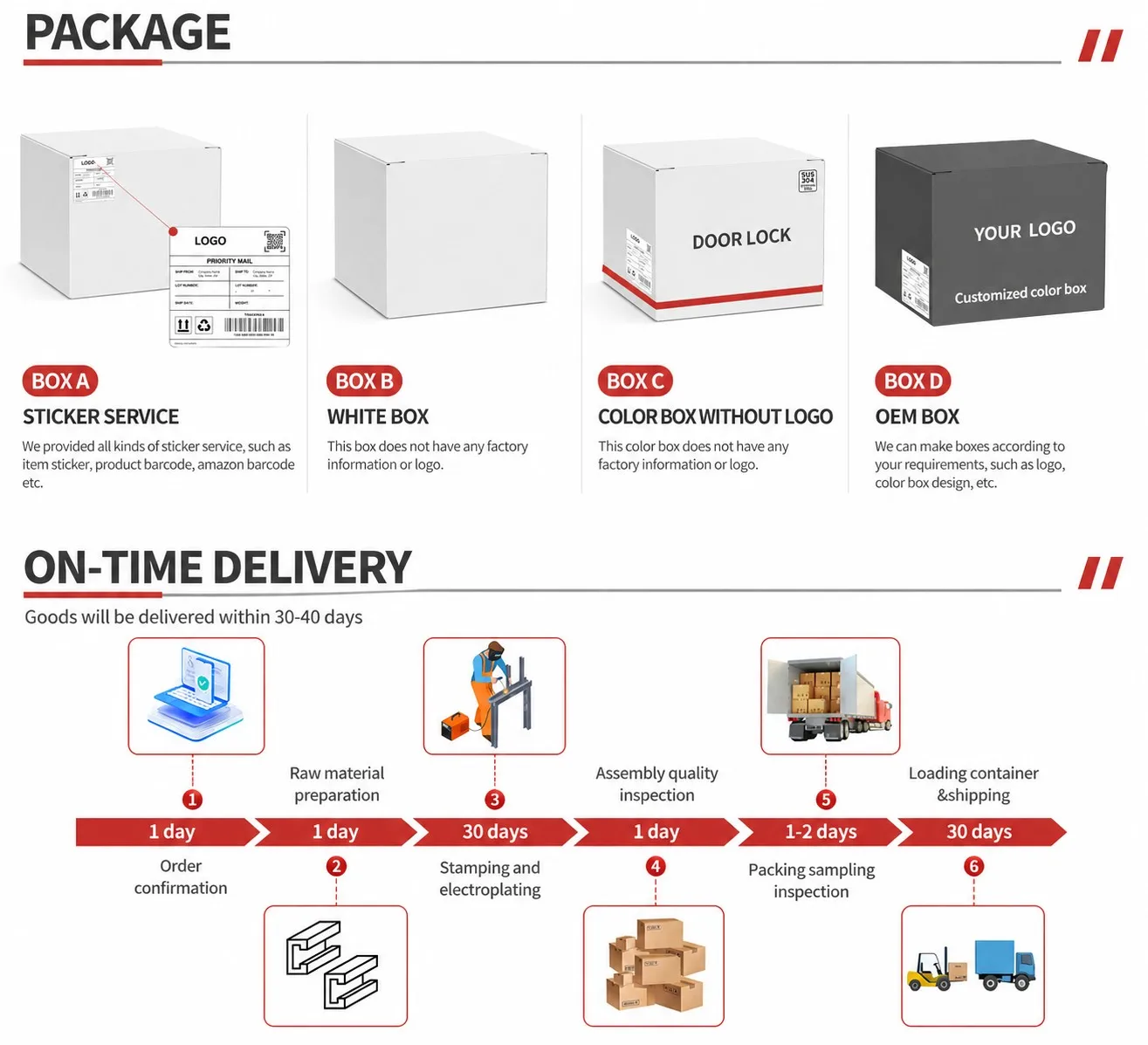
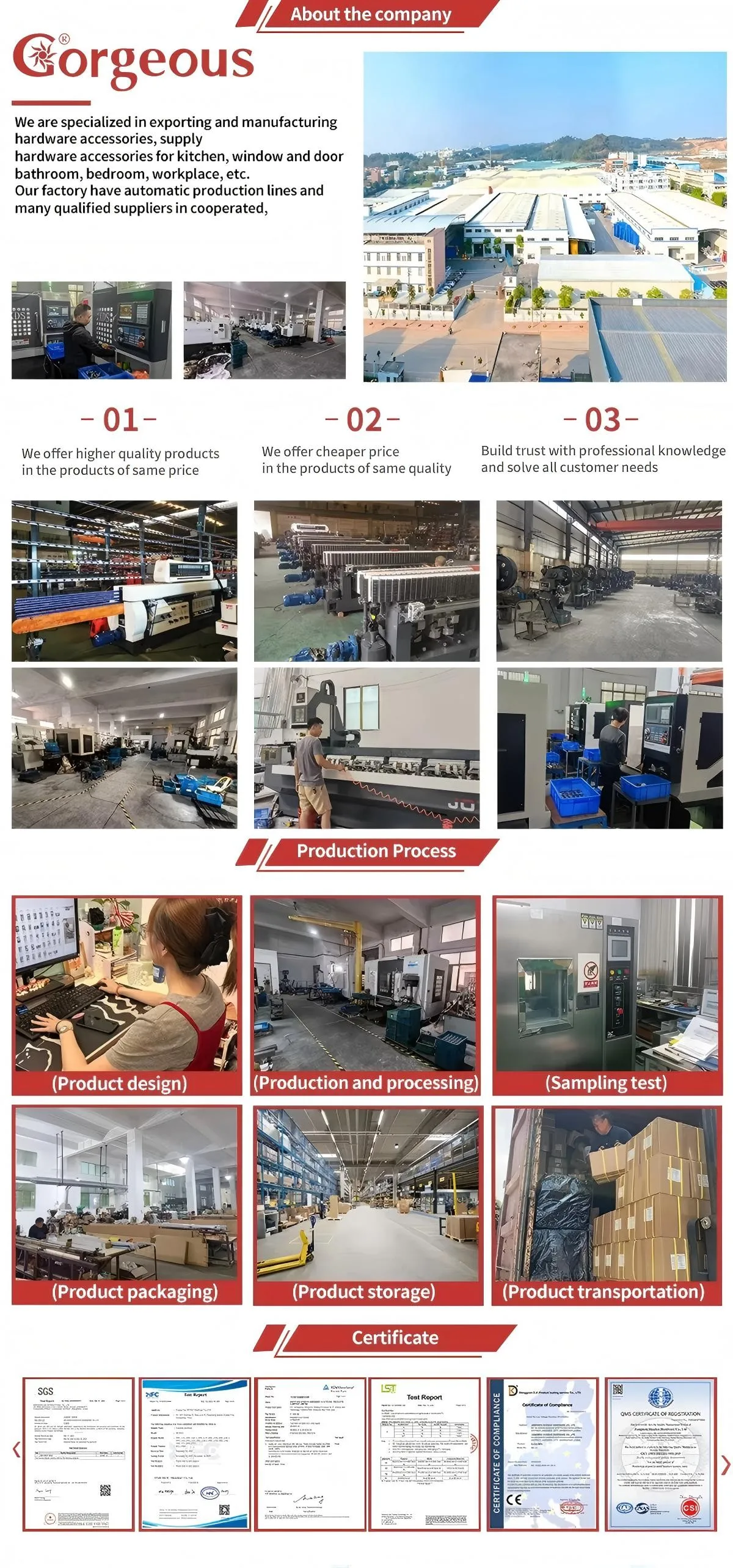
This corner cabinet hinge set is supplied by Guangzhou Gorgeous Intelligent Technology Co., Ltd., a furniture and architectural hardware business whose range covers hinges, drawer slides, handles, stays, legs, castors, locks and the connecting plates that go with them. The company works to export orders: quantity, packing, carton marking, barcodes and shipping documents are agreed before production rather than after it, and the specification written on the order is the specification the factory works from. The hand of the hinge pair, the finish on the brackets, the screw pack and the carton quantity are all part of that specification.


Ordering
Send the model number G-K434 with the number of sets you need, the hand you want if the door is one way round, the carton marking and the destination port, and confirm the corner angle and the panel thickness against the drawing at the same time. Samples are available before a production order so a set can be fitted into an offcut corner and the door run through its arc, which is the fastest way for both sides to agree that the brackets land flat and that the damping takes over where it should. The drawing, the packing list and whatever test documentation we hold for G-K434 are issued on request, and delivery and payment terms are agreed order by order on the proforma rather than assumed from a previous order.


Comprehensive score