


Iron Interlocking Furniture Connecting Plate Set G-K4181
The G-K4181 Iron Connecting Plate Set In Six Photographed Positions

This listing is written from the frames in this folder, and six of the seven are used on this page. What they show is a two plate connecting set in iron. The drawing frame lays the two plates out with six cross head machine screws beside them and carries the size on the frame itself, 49 by 153 millimetres and Material iron. The white background frame shows the same two plates from above. A close up pair frame reads both plates side by side, the L plate at the top with its folded flange and its row of pressed nuts, the strap plate below it with its own row of nuts and both long edges turned up. The strap plate then gets its own close up, where the six nuts and the two turned up rails are the whole of what the frame is about, and the L plate gets two close ups of its own, one from each side, so that the five nut barrels standing proud of the flat face and the two large counterbored clearance holes in the flange are both on the record.
The plate is the unit this set is built from, and it is worth saying at the start what kind of plate this is, because it is not the flat mending plate a buyer may be picturing. A mending plate is a flat plate with wood screw holes, and it is fixed by driving screws through it. This set is the other way round. Each plate carries pressed in threaded nuts, so the plate is the fixed half of a machine screw joint: the plate sits on or against the panel, the nut barrel takes the thread, and the screw comes in from the other side and pulls the panel onto the plate. That is why the nut barrels are visible standing proud of the plate faces in the close ups, and it is the reason a plate of this kind is bought as a pair with its screws rather than as a loose bracket.
The Two Plates The Drawing Marks

Two plates, two jobs. The L plate is the shape that turns a corner: one flat face that lies against a panel, and one flange folded up out of it at a right angle. The drawing marks 153 millimetres along that plate and 49 millimetres across its flat face, and it marks 32 millimetres at the folded end, which is the height the flange stands off the flat face. The flange is where the two large counterbored holes are, and the flat face is where the five pressed nuts are, set in a staggered row rather than a straight line so that the plate spreads its grip across the width of whatever it is fixing. The strap plate is the straight half of the pair: 151 millimetres long and 33 millimetres wide as the drawing marks it, carrying six pressed nuts in a staggered row of its own, with both of its long edges turned up into rails so the plate is a shallow channel rather than a flat strip.
The two marked widths are the part of the drawing that tells a buyer how the pair behaves, and it is worth reading them together. The strap plate is marked 33 millimetres wide, and the L plate's folded end is marked 32 millimetres. A strap plate 33 millimetres wide with both long edges turned up leaves an inside width a shade under 33 millimetres, and a flange 32 millimetres tall is a flange that goes into it. That is the fit the pair is built for: the L plate's flange drops into the strap plate's rails, the plate slides along the rails to where the joint needs it, and the two clearance holes in the flange line up over two of the six nuts in the strap plate so the screws can lock the pair at that position. The plates are a matched pair rather than two brackets from a bin, and the drawing states the two widths that make them a pair.
| Plate | Marked size | What the frame shows on it |
| L plate (corner plate) | 153mm long, 49mm across the flat face, 32mm fold | Two large counterbored clearance holes in the flange, five pressed nuts in a staggered row on the flat face, a raised rib and a small stamped arrow |
| Strap plate (channel plate) | 151mm long, 33mm wide | Six pressed nuts in a staggered row, both long edges turned up into rails, both ends formed |
| Screws in the drawing | Six cross head machine screws | Laid in a row below the two plates, the same count as the nuts in the strap plate |
How The Pair Locks
The pair locks in one movement, and the screws are the whole of it. Set the strap plate on its panel, nut barrels facing out. Drop the L plate's flange into the strap plate's rails. Slide the pair along the rails until the joint sits where the drawing puts it, then run two of the six screws through the two counterbored clearance holes in the flange and into the nuts they are sitting over. The counterbore is what makes that joint sit flat: the screw head sinks into the clearance hole instead of standing proud of the flange, so the flange can slide in its rails without the heads catching, and the load of the joint passes through the flange into the rails rather than through the screw heads alone. Four screws remain. Those four go through the strap plate's other nuts from the far side and hold the strap plate down onto its panel, which is what makes the strap plate the anchored half of the pair and the L plate the half that can be set and re-set.
That division of labour is worth stating plainly because it is what a buyer is actually paying for on a plate set of this kind. A single bracket fixed with wood screws has one position and no adjustment: drill it once and the joint is where the drill put it. A two plate set with rails has a travel along the rails and a lock that can be released, so a joint can be set to the panel that is actually on the bench rather than to the panel the drawing assumed, and a joint that settles can be re-set without filling and re-drilling the panel. For a knock down joint, a sofa frame, a bed rail or a panel that has to come apart for shipping, that travel and that releasable lock are the whole reason the pair exists rather than a bracket.
The Pressed Nuts Are The Point Of The Plate
A plate is only as good as the thread it offers, and on this set the thread is a pressed nut set into the plate rather than a thread cut in the iron. That distinction decides three things a buyer will notice in service. First, the thread in a pressed nut is a machine thread with a defined pitch, so the screw that goes into it is a machine screw and the joint can be assembled and taken apart as often as the job needs without the hole opening up. A thread cut straight into sheet iron loses its bite after a few assemblies, and a wood screw driven into a plate hole loses it the first time. Second, the nut barrel passes through the plate and stands proud of the face, so the barrel carries the load into the panel rather than letting the plate crush against it, and the plate stays flat under torque instead of dimpling round the hole. Third, a nut that is pressed in is a nut that cannot be lost: there is no loose nut to drop behind the panel during assembly, which on a knock down joint assembled on site is the difference between a job that closes and a job that needs a second visit.
The count of nuts on each plate is not decoration either. Five nuts on the L plate's flat face and six on the strap plate mean eleven machine thread fixing points across a pair that is 153 millimetres long, which is a spread of grip that a single bolt joint cannot offer and a load path that a single bracket cannot spread. On a plate carrying a panel that has to stay flat, that spread is what keeps the panel from cupping around one fixing. The staggered rows do the same work in the other direction: nuts set off the centre line reach the plate's edges, so a plate pulled down on its nuts holds across its whole width rather than down a single line.

The close up from the nut side is the frame to read before ordering, because it is the frame that shows the barrels. Every nut in the row stands proud of the plate face by its own barrel, and the barrels sit in a staggered line that follows the plate's length rather than the middle of it. A buyer bedding a plate of this kind into a rebate or a channel is bedding the plate plus its barrels, so the barrel height is a figure to ask for against the drawing rather than to guess from the frame: it is the one dimension that decides whether the plate sits flush or stands off. The raised rib along the plate and the small stamped arrow beside it are forming marks, the rib stiffening the plate along its length and the arrow marking the direction the plate is meant to sit, and both are visible in the close up for the same reason the barrels are: they are part of the plate rather than an afterthought on it.
What The Frames In This Listing Prove
Every structural claim on this page can be pointed at in one of the frames. The two plates and the six screws are in the drawing frame with the size written on it. The L plate's flange, its two counterbored clearance holes and its five pressed nuts are in the close up pair frame and in both of the L plate close ups. The strap plate's six nuts and its two turned up rails are in the close up pair frame and in the strap plate close up. The barrels standing proud of the plate face are in the nut side close up, and the rib and the stamped arrow are in the same frame. What no frame on this page proves is the thread size of the nuts, the barrel height, the plate thickness, the grade of the iron and the load a pair carries, and none of those figures is carried here as a photograph fact. They come from the plate drawing and the test report for this model, and a figure borrowed from a similar looking plate is the kind of typo that shows up on site rather than at the desk, so they are issued against G-K4181 rather than assumed.
Two things are stated as class behaviour rather than as frame facts, and both are worth naming. The interlock is one: the two marked widths, 33 millimetres across the strap plate and 32 millimetres at the L plate's folded end, are what make the pair a pair, and the frames show both widths and both plates, but a photograph cannot prove a slide fit, so the fit is worked on a sample with the buyer's own panel before a production order is cut. The hold of the pressed nuts is the other: the frames prove the nuts are there and set through the plate, not that a given nut takes a given torque, so the torque figure is issued against the drawing and confirmed on the sample. A plate set sold on the strength of its photograph alone is a plate set that gets returned, and the two checks above are what a trade buyer does anyway before committing to a container.
The staged set also omits, on purpose, the one source frame that repeats a view already on the page. The remaining frame is a second close up of the strap plate taken from a slightly different angle, and it carries the same six nuts in the same staggered row and the same turned up rail as the strap plate close up that is used, so it adds a second picture of one view rather than a seventh view. What remains is six different views of the set, and each of the six is used once in the gallery on this page.
How The Set Is Built
Read the white background frame and the close up pair together and the construction of the set is plain. Each plate starts as a flat iron blank, the nuts are pressed into it, the flange is folded up on the L plate, and the rails are turned up on both long edges of the strap plate. The clearance holes in the L plate's flange are punched and counterbored so a screw head sinks flush, and the rib is formed along the plate rather than welded onto it. Nothing on either plate is welded, which matters on a plate that has to sit flat against a panel: a weld draws the plate and a drawn plate will not lie down. The finish across both plates is the same bright silver, uniform across the flats, the folds and the nut barrels, and it is the finish the frames show rather than a finish named here.
- Two plate set in iron: one L plate with a folded flange, one strap plate with both long edges turned up into rails.
- L plate marked 153 millimetres long, 49 millimetres across the flat face and 32 millimetres at the folded end.
- Strap plate marked 151 millimetres long and 33 millimetres wide, a channel rather than a flat strip.
- Five pressed threaded nuts in a staggered row on the L plate's flat face, six on the strap plate.
- Two large counterbored clearance holes in the L plate's flange, punched and counterbored so the screw heads sink flush.
- Six cross head machine screws supplied with the pair, the same count as the nuts in the strap plate.
- Raised rib and small stamped arrow formed into the L plate, the rib along its length and the arrow marking the seating direction.
- Flat plate against the panel with the nut barrels carrying the load, so the plate stays flat under torque.
Where A Two Plate Set Earns Its Keep
A plate set of this shape turns up wherever a joint has to be flat, strong and able to come apart, and one pair of plates does three jobs that the trade calls by three different names. Used as a furniture connecting plate on a sofa frame, the strap plate anchors to the frame rail and the L plate turns the corner onto the section that has to be joined, and the rails let the two sections be pulled together and set before the screws are locked. Used as a sofa connector bracket between two sections, the same rails let the pair be slid to the line the two sections actually meet on, which is the adjustment a fixed bracket cannot make once it has been drilled. Used as a bed frame bracket, the L plate's flange takes the load of the rail and the strap plate's six nuts take the machine screws that hold the rail to the post, which is the joint a hook style rail bracket cannot offer because a hook bracket has no thread and no adjustment. On a cabinet, a counter or any other panel that is too thick for a cam fitting, the pair does the work of a knock down connector with a spread of fixing points rather than a single cam, and it does it without a rebate cut into the panel face.
A buyer looking for a furniture connecting plate, a sofa connector bracket or a bed frame bracket is looking at the same two plates in three different jobs, and the reason the same pair serves all three is that the plate carries the thread rather than the panel. The plate is what a knock down joint is short of: a flat surface that spreads the load, a set of machine threads that survive being assembled and released, and a travel that lets the joint be set to the part that is on the bench. A cabinet, a bed and a sofa are three different products and one joint problem, and a pair of plates that solves it in iron is a pair a buyer can carry across a whole range rather than specify one model at a time.
The plate set also suits a joint that has to be serviced. A plate fixed by wood screws through it can only be removed by pulling the screws out of the panel, and each removal opens the holes a little wider. A plate set locked by machine screws into pressed nuts can be assembled and released as often as the job needs, because the thread that wears is in the nut and the nut is a part that can be replaced rather than a hole in the panel that cannot. For a hire fleet, a display unit, a shop fixture that is reconfigured, or any product that ships flat and is assembled by the customer, that repeatability is the specification rather than a bonus, and it is the reason the pair is sold with its screws rather than as two plates on their own.
What To Confirm Before The Order Is Cut
Four figures are worth confirming against the drawing before a production order, and none of them is a figure a photograph can give. The thread size of the nuts is the first, because it decides which machine screws the joint takes and whether the screws in the buyer's own assembly will fit. The barrel height is the second, because a plate that has to sit flush in a rebate is a plate whose barrels fit the rebate. The plate thickness and the iron grade are the third, because they set how much the plate will take before it bends, and the finish is the fourth, because the bright silver in the frames is one finish among several and a position near salt air wants a different one. All four come off the drawing, and all four are answered on request rather than left to be read off a picture.
Two checks are worth doing on the sample rather than on paper, and a trade buyer normally does both. The slide fit of the flange in the rails is the first: with the buyer's own panel under the strap plate, the flange should drop into the rails and travel without side play and without needing to be forced, and a fit that has to be tapped in is a fit that will gall once the finish wears. The lock is the second: two screws through the flange into their nuts should pull the pair up square with no gap opening at the fold, which is the check that tells a buyer whether the counterbore and the nut line up on the batch in hand. Both checks take a minute on a sample and neither is answerable from a photograph.
- Thread size of the pressed nuts confirmed against the drawing, so the machine screws match the buyer's assembly.
- Barrel height confirmed against the drawing, since a plate bedded in a rebate is bedded with its barrels.
- Plate thickness and iron grade confirmed, because they set what the plate takes before it bends.
- Finish confirmed for the position, with a salt air or exterior use agreed against the drawing rather than assumed from the bright silver in the frames.
- Slide fit of the flange in the rails checked on the sample in the buyer's own panel, with no side play and no force needed.
- Lock checked on the sample, two screws through the flange pulling the pair square with no gap at the fold.
- Screw specification and count agreed for the assembly, with the six screws in the drawing as the reference count.
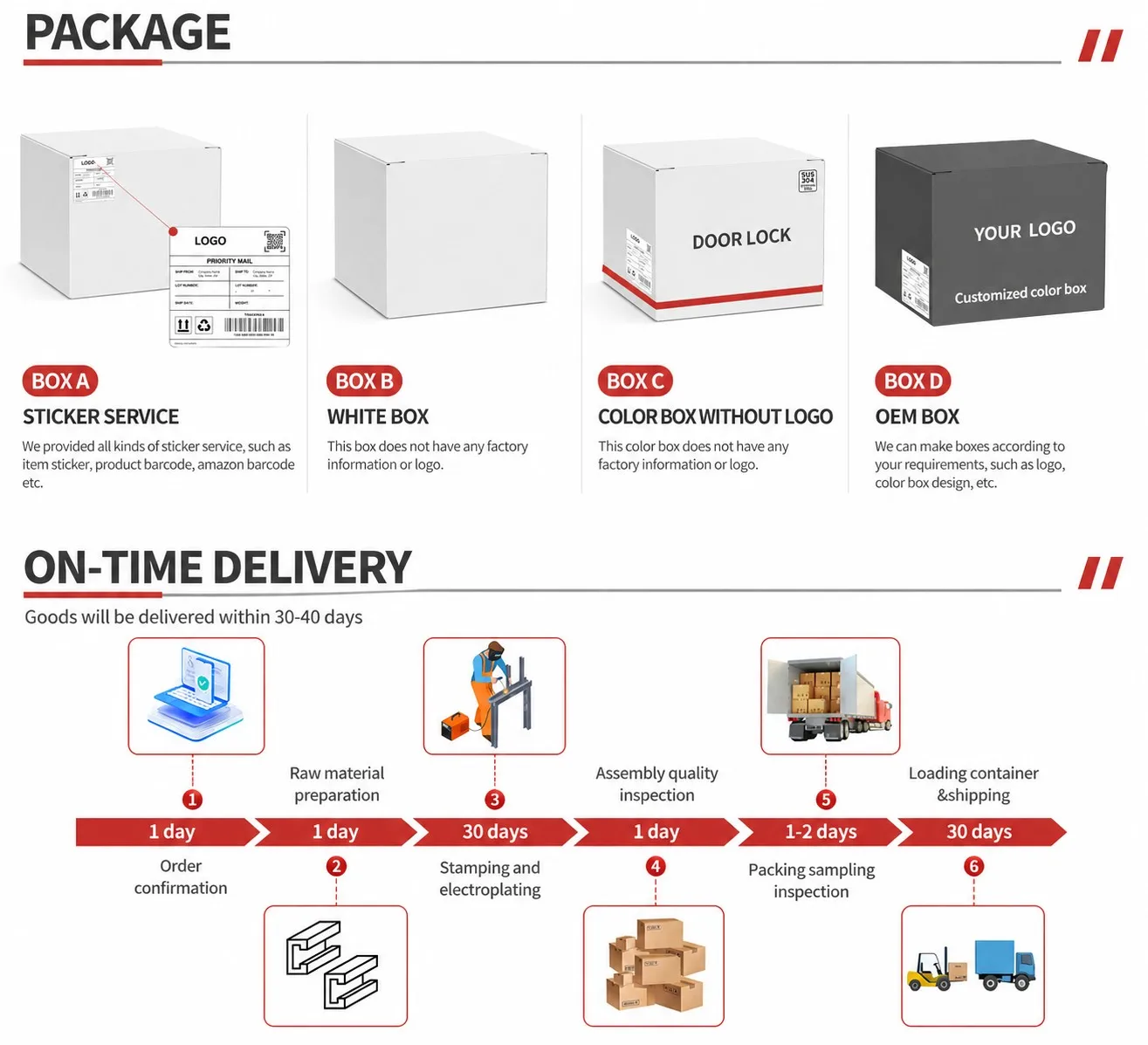
- Packing and carton marking agreed for a mixed order, so the plates and the screws arrive as a matched set.
Ordering
Send the model number G-K4181 with the count you need, the destination port and the carton marking you want, and confirm the thread size and the finish against the drawing at the same time. Samples are available before a production order so the pair can be assembled on your own panel, the flange dropped into the rails and the two screws run into their nuts, which is the fastest way for both sides to agree that the slide fit, the counterbore and the thread are right on the batch in hand. The plate drawing, the fixing sheet and whatever test documentation we hold for G-K4181 are issued on request, and delivery and payment terms are agreed order by order on the proforma rather than assumed from a previous order.
Who Supplies This Plate Set
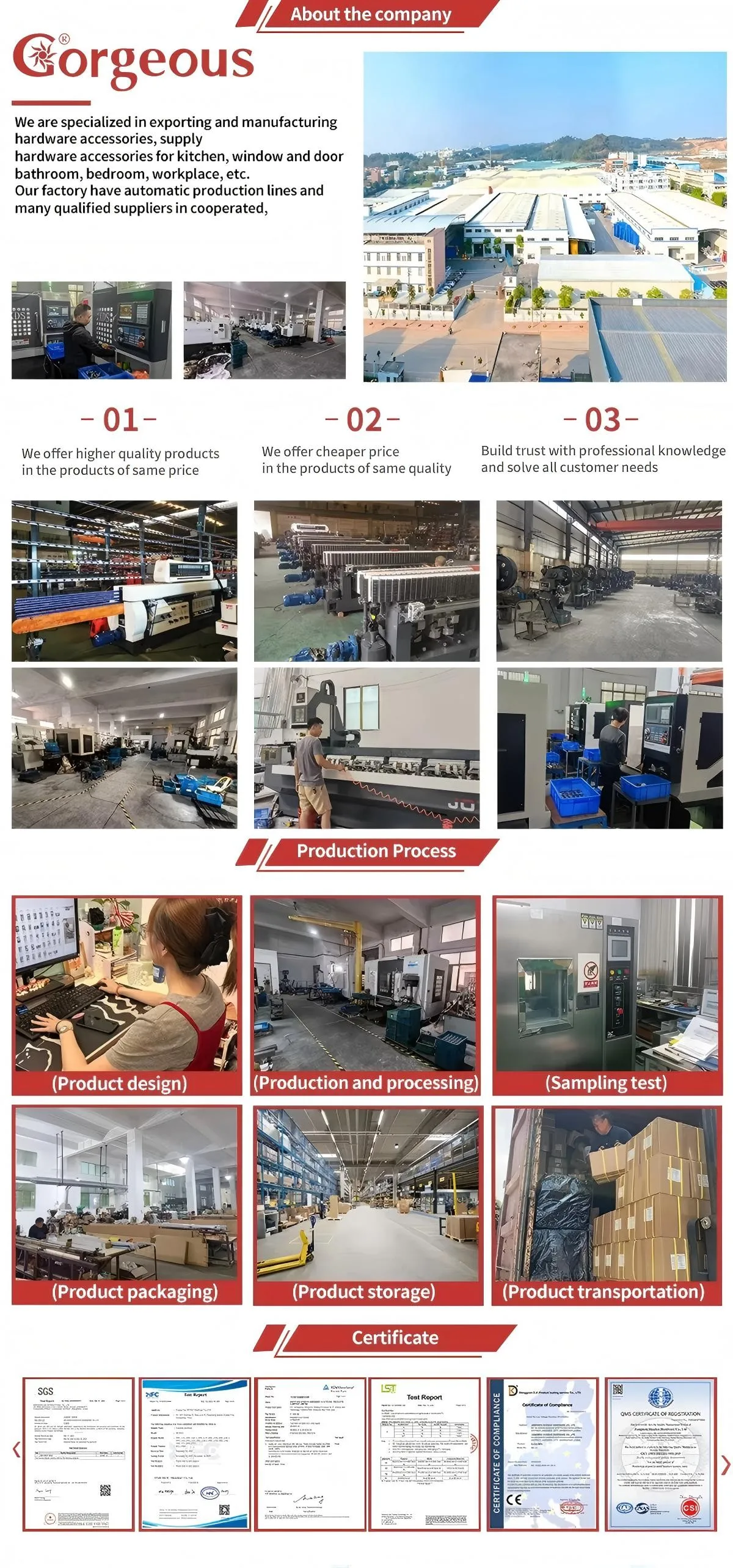
This plate set is supplied by Guangzhou Gorgeous Intelligent Technology Co., Ltd., a furniture and architectural hardware business whose range covers hinges, drawer slides, handles, stays, legs, castors, locks and the connecting and fixing plates that go with them. The company works to export orders: quantities, carton marking, barcodes and shipping documents are agreed before production rather than after it, and a buyer who specifies the thread size, the plate thickness and the finish on the order gets those things made, because that is the only specification the factory works from.





Comprehensive score