


Six Hole Corner Brace 30 x 30 mm G-JM17
The G-JM17 Six Hole Corner Brace
Three holes in a leg is one more than most corner braces carry, and the extra hole is what makes this brace useful on the joints that actually fail. Two holes hold a corner against opening. Three hold it against opening and against sliding along the grain, because the third hole is set back from the other two and takes the load from a different direction.

Both legs are 30 mm and carry the same three-hole pattern. The holes sit as a pair near the outer edge with the third set back towards the fold, so a screw in the pair pulls the brace down onto the face and the third screw stops the brace rotating about that pair. The drawing that travels with this listing prints 18 mm and 16 mm as the two distances inside that triangle, and those two figures give the pattern exactly.
The Figures
| Figure | Value | What it decides |
| Leg | 30 mm both legs | reach on each face of the joint |
| Holes | 3 per leg, 6 in total | two holding, one stopping rotation |
| Hole triangle | 18 mm and 16 mm | the two printed distances inside the pattern |
| Thickness | 1.8 mm black / yellow zinc | the sheet the brace is folded from |
| Thickness | 2.8 mm bright | the heavier version of the same brace |
The pressed bead along the fold is the other half of the story. A plain fold at 90 degrees is a hinge: it will hold the angle until the load comes on, and then it opens slightly and never closes again. The bead is a formed rib running the length of the fold on both faces, and it turns that line into a stiffened section so the angle stays at 90 degrees under load. It is the difference between a brace that holds a carcass square and one that only looks as if it does.

Three Finishes, One Brace
The same brace is supplied black, yellow zinc and bright. The choice is about where it goes, not about strength, with one exception: the bright version in these frames is the heavier of the three at 2.8 mm, while the black and the yellow zinc are 1.8 mm. Where the load is the reason for buying the brace, that is the one to specify.
Black suits a brace that will be seen on dark furniture, and it hides the marks a driver leaves better than either of the plated finishes. Yellow zinc is the workshop default: cheap, corrosion resistant enough for indoor work, and it does not show handling marks. Bright is the finish to pick where the brace has to look like part of the fitting rather than an addition to it.

Why The Rib Matters More Than The Thickness
A brace fails at the fold, not in the middle of the leg. The leg is supported by whatever it is screwed to; the fold is supported by nothing, and it is where the angle either holds or gives. Adding thickness to a plain fold helps, but not as much as forming a rib into it, because the rib puts material where the bending moment is highest rather than spreading it evenly across a flat section that is doing very little.
That is why a ribbed brace of modest thickness will outperform a flat brace of heavier sheet on the same joint, and why the bead is worth looking for on a sample rather than assuming it from a photograph. On these frames it is clearly formed, with a clean transition at both ends and no thinning of the sheet at the shoulder.
Fitting
Pilot the timber, not the brace. The holes are punched and deburred, and running a drill through them only adds a chamfer that lets the screw head sink and the plate lift at the other end. Mark through the plate, take the brace off, drill the pilots, then refit and drive.
Drive the pair first, then the third hole. On a joint that is slightly open, the pair will pull it closed and the third screw then locks it. Reverse the order and the third screw holds the joint open while the pair fights it.
What Buyers Call It
Three phrases bring this part in. The first is a black corner brace, the phrase used where the finish is the reason for the purchase and the brace is going onto dark furniture or a frame that will be seen. The second is a 30mm corner bracket, the phrase used where the leg length is the deciding figure, which on a brace of this size is usually the case because it has to sit inside a corner without showing. The third is a 6 hole corner bracket, the phrase used by anyone who has already had a two-hole brace pull out and knows the hole count is what they are buying.
All three point at the brace in these frames, and none of them carries the finish and the hole count together, which is why the frames show all three finishes side by side and the table gives the count. A buyer who orders from a photograph of one finish and receives another has ordered from an incomplete listing, and the listing is at fault, not the buyer.
Ribbed And Plain, Side By Side
The rib is easy to talk about and hard to see in a small photograph, so it is worth knowing what to look for. On a ribbed brace there is a raised band running along the fold on both faces, with a shoulder at each end where the metal steps up and back down. On a plain brace the fold is a single line. Put the two side by side and press on the corner: the plain brace will flex and the ribbed one will not, which tells you more about how the joint will behave after two years than any load figure on a carton.
The rib also changes how the brace sits. On a face that is not perfectly flat, the rib keeps the leg off the surface along that band, so the brace contacts the timber on two lines rather than across the whole face. That is fine on solid timber and worth thinking about on a soft board, where the contact lines will compress and the brace will settle slightly under the first load.
Screws, And Why Size Matters Here
A 30 mm leg takes a short screw, and the temptation is to use one that is too short because the brace is small. The screw has to be long enough to reach through the brace and into sound timber, which on a 30 mm leg into an 18 mm board means a fixing that engages most of what is there. Undersized screws are the commonest reason a brace of this size pulls out, and it is the fixer's choice, not the brace's fault.
Use the same screw in all three holes. A longer screw in the third hole will pull the brace out of line with the pair, and the brace will then sit at a slight angle to the joint it is supposed to be holding square.
How Many Braces A Carcass Needs
A carcass needs a brace at every corner that is not held by a back panel. Four corners, four braces is the ideal; two braces on the same diagonal is the minimum that will keep a box from racking, and it is the arrangement used where the other two corners are hidden or where a brace would foul a drawer. Put those two braces on opposite diagonals rather than on the same face, and the box resists racking in both directions instead of only one.
On a frame rather than a box, the brace goes on the face that sees the load. A bench takes its load downwards on the top rails, so the braces belong under the rails where they are in compression, not on the legs where they would only hold the leg square. Fitting a brace in the wrong plane is a common mistake and it produces a frame that is stiff in one direction and loose in the other, which feels like a loose joint rather than a misplaced brace.
Repairing A Joint That Has Already Failed
Where a joint has opened and the old screw holes are oval, the brace goes on slightly offset rather than over the original holes, so that every screw in the new brace finds sound timber. Fill the old holes before fitting, with a glued plug rather than a matchstick, and the brace has something to pull against instead of compressing a void.
On a joint that has failed once, a second brace is often the honest answer rather than a bigger one. Two braces set at right angles to each other on the same corner hold the joint in two planes, and a corner held in two planes will not open again in either. A single heavier brace still only holds one plane, however thick the sheet it is folded from.
Where A Six Hole Brace Is The Right Call
- A carcass corner that has to stay square while it is moved, one brace per exposed corner.
- A drawer box where one screw per leg has already pulled out.
- A bed frame corner, where the load changes direction every night.
- A chair or bench frame that rocks and has started to open at the joints, braced under the rail.
- A shelf unit built from board that is too thin for a two-hole brace.
- A display or shopfitting frame that is assembled and taken apart.
- A repair where one of the original holes is now oval and useless.
- A flat pack item being rebuilt after a move.
Two Holes Or Three
A two-hole brace is the right part where the joint is only ever loaded in one direction, and where the brace has to be short. A three-hole brace is the right part as soon as the joint can move, because the third hole is what stops the brace turning about the first pair. On a soft board the third hole also spreads the load over one more fixing, which is usually what stops the screws tearing out rather than the brace bending.
The cost is one more screw and one more pilot hole per leg, which is why cheap furniture uses two and why anything that has to survive being used uses three.
Corrosion, And Which Finish To Choose Outdoors
None of these three finishes is a weathering finish. Black is a coating over steel and will chip at the edges; yellow zinc is a passivation over electroplate and will go white then red at the punched edges; bright is plated and behaves like the yellow zinc. Indoors all three outlast the furniture. Outdoors, under cover, all three will last years. In full weather, none of them will, and the conversation should move to stainless before the order rather than after the first winter.
Where a brace is going into treated timber, check the fixings as well as the brace: the aggressive salts in some treatments attack plated steel at the contact point long before the exposed faces show anything. Stainless screws in a plated brace are a reasonable compromise, but they do not stop the brace itself from going at the holes.
Checking A Sample
Four checks. The bead: it should run the full length of the fold and fade out at both ends without a crease. The angle: stand the brace on one leg and sight the other against a square, because a brace folded at 88 degrees cannot be pulled square by the screws. The holes: no burr on the face that will sit against the timber. The finish: an even coat with no bare patch inside the bead, which is where a coating misses first.
Check the thickness with a micrometer rather than by eye, particularly across the finishes. The bright version is the heavier of the three and it is easy to ship the lighter one against a heavier order if the parts are counted by eye.
Packing
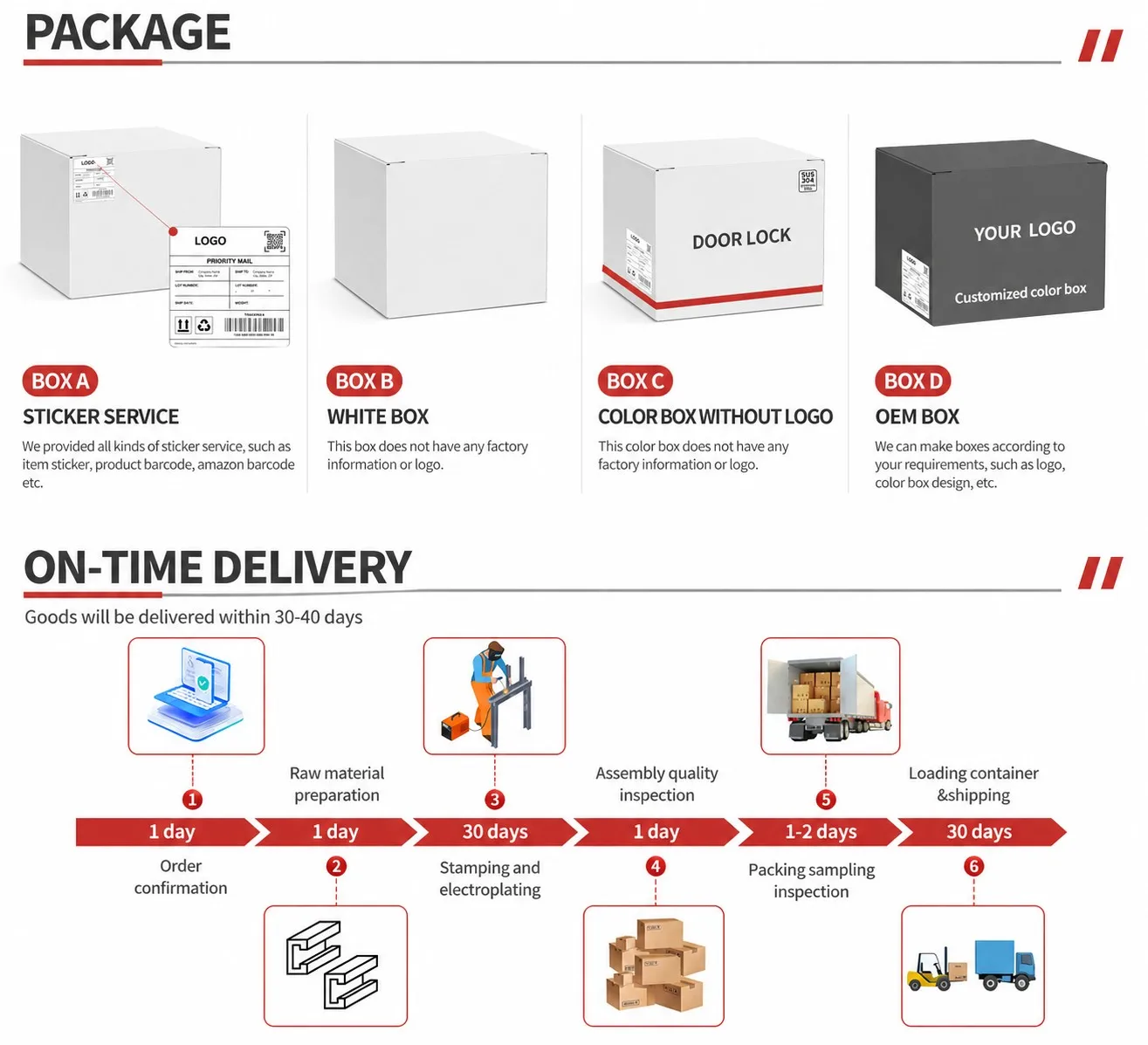
These are small parts that arrive in quantity, so the packing decides the state they arrive in. Bag by finish first and never mix finishes in one bag: black coating marks the plated parts, and a mixed bag cannot be counted. Inside the bag, the braces should be nested the same way round so the beads do not rub against the holes of the next brace.
For export, mark the finish and the thickness on the bag as well as on the carton. A carton is opened and resealed on site and the marking goes with it, which is how a mixed shipment gets built.




The G-JM17 brace has 30 mm legs, three holes per leg and a pressed bead along the fold, and is supplied black, yellow zinc or bright, the bright being the heavier sheet.
Say which finish and which thickness, and the brace can be checked against the joint before anything ships.


Comprehensive score