


Yellow Zinc Flat Joining Plate 80 x 38 mm 1.4 mm G-JM16
The G-JM16 Flat Joining Plate In 1.4 mm Steel
This is the same plate as the lighter gauge in the same range, made from a heavier strip. Everything that changes when the steel gets thicker changes here: the plate stops conforming to a surface that is not flat, it will not dimple under a screw head, and it holds a load across a joint instead of merely closing it. Everything that gets harder gets harder here too, which is the part that matters on site.

The plate is 80 mm long and 38 mm wide, with eight holes in two columns of four. Along the plate the hole centres are set 16 mm from the end, then 31 mm, then 16 mm; across the plate the two columns are 24 mm apart. Those five figures decide the whole fixing pattern, and they are printed on the drawing that travels with this listing rather than estimated from the photographs.
The Figures That Matter
| Figure | Value | What it decides |
| Length | 80 mm | span across the joint |
| Width | 38 mm | two columns of holes, 24 mm apart |
| Thickness | 1.4 mm | load carry, and how hard it is to form |
| End margin | 16 mm | hole to plate end, both ends |
| Middle pitch | 31 mm | gap between the two inner holes |
The 1.4 mm thickness is the reason to buy this plate over a lighter one, and it is also the reason it needs different handling. A thick plate will not follow a cupped board. Laid on a panel that is not flat it will rock, and the screws will pull it down at the ends and leave the middle standing proud, which puts the load on two screws instead of eight.

Why A Thicker Plate Behaves Differently
A thin plate is a strap: it bends to the surface, it dimples into a gap, and it works because the screws clamp it flat. A thick plate is a beam. It refuses to bend, so it distributes load between the fixings along its length instead of concentrating it at the two nearest the joint, and it holds a joint that has already opened rather than following it closed. That is what makes the thicker gauge the right choice on a gate that has dropped, a bench that racks under load, or a crate that is handled by a forklift.
The cost of that behaviour is that a thick plate is unforgiving about the surface underneath. On a flat board it is better in every respect. On a twisted board it is worse than a thin one, because it cannot follow the twist and the joint will be held straight while the timber around it is not.

Driving Screws Into Thicker Steel
Two things change. The pilot hole in the timber stays the same, because that is set by the screw and not by the plate. The screw itself has to be longer: the plate now takes 1.4 mm of the screw before the thread reaches timber, so a screw that was only just long enough in a thin plate will bottom out in the plate and never grip. Add the plate thickness to the screw length when the fixing was specified for a lighter plate.
The second change is the head. A countersunk screw in a thick plate sits in a cone that is punched rather than formed, and a head that is slightly oversize will stand proud of the face. That matters where the plate sits under a drawer bottom or inside a carcass, and it is worth checking one screw in one hole before driving a hundred. Pan or wafer heads sit on the face rather than in it, which is fine where there is clearance and wrong where there is not.
How The Holes Are Punched
The holes are punched slightly oval rather than round, elongated across the plate. That is not a defect and it is not a slot: it gives the joint a little movement as the timber takes up its moisture, which is what stops a plate tearing the grain around a tight hole on the first dry spell. On a repair where the two members have already moved relative to each other, the oval lets the screws find their position instead of forcing the joint back to where it was.
It also means the plate can be set slightly off-line and still take all eight screws. On a long run of plates along a joint, that tolerance is what keeps the run straight when the first plate has been set by eye.
The Three Names This Plate Answers To
A buyer looking for this part may type any of three things. The first is a heavy duty flat bracket: the phrase used on marketplace listings where the plate is sold as a general-purpose reinforcement rather than a repair, and the one that brings in the buyer who knows the part will be loaded. The second is a straight brace bracket, which is the merchant term for a flat plate that runs straight across a joint rather than turning a corner, and which separates this part from an L bracket in a search result. The third is a wood joining plate, the phrase from the timber trade: the part is bought to join two members into one length rather than to repair a break.
All three describe the same object in these frames, and none of them carries a size. A plate can be anything from a finger plate to a joist strap under those words, so the figures travel with the listing: 80 mm long, 38 mm wide, 1.4 mm thick, eight holes.
One Plate, One Joint, Or A Run
A single plate is a repair. A run of plates along a splice is a joint, and a run is specified differently: the plates are spaced so that each takes an equal share of the load, usually one plate width apart with the holes staggered between adjacent plates so that no two screws sit in the same grain line. Staggering matters more on a thick plate than a thin one, because a thick plate transfers load between its own holes rather than letting the timber share it, and a row of holes in one grain line is a split waiting to open.
On a splice that will be seen, set the plates on opposite faces and offset them along the joint. Two plates on the same face, one behind the other, add almost nothing: the load path is already formed by the first plate and the second only repeats it.
Where A 1.4 mm Plate Is The Right Call
- A gate that has dropped and needs its stile and rail pulled back into line.
- A bench or table apron that racks when the table is leaned on.
- A crate or pallet repaired for a second run rather than scrapped.
- A fence panel or trellis frame carrying wind load at a butt joint.
- A joist or rafter repair where a sistered member takes the load.
- A shelf bracket or gallows support carrying a continuous load.
- A door frame that has been kicked and needs the lining stitched back.
- A formwork or staging panel where the joint is knocked apart every week.
Where A Thicker Plate Is The Wrong Answer
Thin panel goods. On a manufactured board under about a third of the plate thickness, the failure moves from the plate to the panel: the screws tear through the board and take a ragged plug with them. A lighter plate spreads the same load over a larger area because it sits flat, and a thick plate standing proud of a thin panel concentrates the load at four contact points instead.
Decorative faces. A thick plate has a visible edge and no give, so it shows every gap under it. Where the plate will be seen, either recess it or use a thin one. This is a workshop part, not a trim part, and it should be specified as one.
Setting A Plate Square On A Joint
Clamp the joint closed first and check the two faces with a straight edge before the plate comes out of the bag. A plate fitted to a joint that is still open will hold it open. Mark the eight hole positions through the plate with a brad point, take the plate off, drill the pilots, then refit: drilling through the plate heats the punchings and walks the bit, and on a thick plate the bit wanders further before it bites.
Drive the four corner screws first, diagonally, then the inner four. The corners set the plate on the surface and the inner screws only clamp it. Reverse that order and the inner screws pull the plate down in the middle while the corners are still loose, and the plate ends up bowed against the timber.
Finish, And What Yellow Zinc Will Do
Yellow zinc is a passivation over electroplated zinc, and it is chosen because it survives handling better than bright zinc and costs less than stainless. It is not a weathering finish. Indoors, or under cover, it will outlast the joint it holds. Outdoors in persistent wet, the zinc goes first at the punched edges and around the holes, which is where the steel is exposed, and the plate will start to show rust at those points within a season or two of full weather.
Where the plate is going outdoors, say so at enquiry. A plated plate can be supplied, or the same geometry in stainless, and the choice is worth making before the order rather than after the first winter.
Checking A Delivery
Four checks on the pallet. Thickness: a micrometer at three points along the plate, because the strip is the specification and a plate rolled from a lighter strip cannot be told from the outside. Punchings: no burr on the face that will sit against the timber, and no hole pushed out of line. Flatness: the plate should sit on a surface plate without rocking. Finish: an even yellow with no bare patch at the sheared ends, because a bare end is where the rust starts.
Count by weight as well as by piece on a large order. A thicker plate is easy to miscount and hard to tell from a photograph afterwards.
Packing And Export
Steel plates are packed by weight, not by volume, and the carton has to be lined for that. Plates are banded in bundles with edge protection so that the bands do not cut into the corners, and bundles are separated so that they can be counted on arrival. Where the finish matters, interleave the plates: yellow zinc rubbing against yellow zinc for a week in a container will polish the passivation off the high spots.
Mark the bundle count and the gauge on the outside. A carton marked only with a part number cannot be checked against the order without opening it, and a carton that has been opened is a carton that has been counted twice.

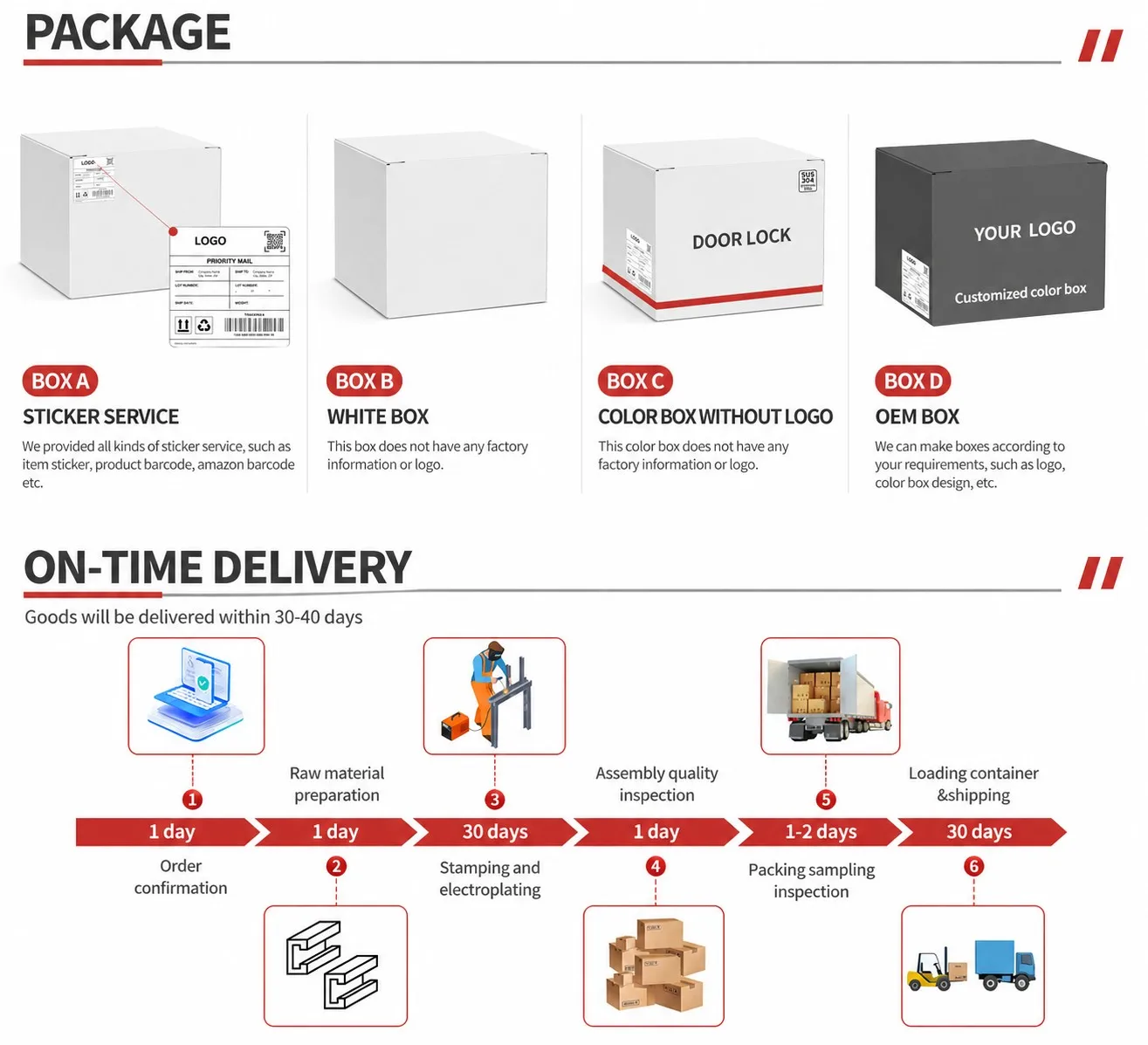



The G-JM16 plate is 80 mm by 38 mm in 1.4 mm steel, eight holes in two columns of four, yellow zinc, packed in banded bundles to a count.
State the gauge and the member it is going onto, and the plate can be checked against the joint before anything ships.


Comprehensive score