


Zinc Furniture Corner Bracket 52 x 52 mm G-JM19
The G-JM19 Wide Furniture Corner Bracket
Most corner brackets are narrow, because most of them go inside a cabinet where the member is thin. This one is wide: a 40 mm face on a 52 mm leg. That ratio is chosen for the frames that are built from wide material, where a narrow bracket puts all eight screws in a line down the middle of the member and leaves the edges of the joint unsupported.

The legs are 52 mm and the face is 40 mm across, with four holes in each leg set as two rows. Along the leg the rows are 27 mm and 24 mm apart, which is what gives the bracket its grip: the outer row lands near the edge of the member and the inner row lands near the fold, so a load applied to the corner is shared between two lines of fixings rather than one.
The Figures
| Figure | Value | What it decides |
| Leg | 52 mm | reach along each member |
| Face | 40 mm | width across the member it lands on |
| Hole rows | 27 mm and 24 mm | spacing of the two pairs in each leg |
| Holes | 4 per leg, 8 total | two lines of fixing per face |
A bracket this wide is stiffer than a narrow one for the same gauge, because width is what resists the bracket bending across the face of the member. It is not stiffer at the fold: the fold is a line, and a line does not care how wide the sheet is. That is what the pressed rib is for, and on this bracket the rib runs the full length of the fold on both faces.

Why A Wide Face Matters On A Bed Frame
A bed frame is the joint this bracket is most often bought for. The rail is wide, the load changes every night, and the failure is not usually a broken bracket: it is the rail splitting along the line of the screws. A narrow bracket puts every fixing on one line down the middle of the rail, and that line is the grain line, which is the weakest place to put eight screws. A 40 mm face lets the holes sit in two rows either side of the grain, so the rail is loaded across its width instead of along it.
The same argument applies to a bench apron, a planter, a crate and a gate stile, and it is the reason to choose a wide bracket over a narrow one even where the narrow one is heavier. Thickness resists the fold; width resists the split.

Fitting A Wide Bracket
Mark all eight holes through the bracket before drilling anything. On a wide bracket it is tempting to drill the two outer rows first and let the inner ones follow, but the bracket has no give and a hole drilled a millimetre out will hold the bracket off the face. Drill the pilots, clear the swarf, then refit and check the bracket sits flat before a screw goes in.
Drive the row nearest the fold first on each leg. That row squares the bracket to the joint, and the outer row then only clamps. Reverse it and the outer row pulls the bracket away from the fold and the joint ends up held at a slight angle, which on a bed frame is audible every time someone turns over.
Finish
Yellow zinc is a passivation over electroplate. It is the right finish for a bracket that will be inside a frame and never seen, and it is not a finish for weather. On a planter, a gate or anything that stays outdoors, the plating goes first at the punched holes and at the sheared ends, and once it is gone the steel goes quickly at the points that carry the load. Ask for stainless for anything that lives outside.
Ordering The Right Pair
Brackets of this size are usually bought in pairs or fours, one per corner. A box needs four if there is no back panel and two on the diagonal if there is. A bed needs two per corner if it is to stay quiet. Ordering a single bracket for a corner that will be loaded is the commonest mistake with a part this size, because one bracket holds an angle and two hold a joint.
Keep the count and the pairs together in the bag. A pair that has been split between two bags arrives as one bracket and one bracket, and a frame built with mismatched pairs is a frame that will be repaired.
Storage Before Use
Zinc plated brackets kept in a damp workshop will go white before they are fitted, particularly where they are stacked and the faces cannot dry. Keep them in the bag until they are needed, and do not store them in the same box as stainless or aluminium: two dissimilar metals in contact in a damp box will corrode at the contact points, and the zinc is the one that goes.
Four Joints This Bracket Suits
Bed frames, because the rail is wide and the load is repeated. Bench and table aprons, because the apron takes the racking when the table is leaned on. Planter and trough corners, where the boards are wide and the joint is expected to survive being dragged. And crates or staging, where the joint is knocked apart and rebuilt and the screws have to find sound timber each time.
What those four have in common is a wide member and a joint that moves. Where the member is narrow, or the joint never moves, a smaller bracket does the same job for less money and takes less of the member.
Two Brackets Instead Of One
On a bed corner the usual arrangement is one bracket on the inside face and one on the outside, or a single bracket plus a bolt through the leg. Two brackets on opposite faces turn the corner into a clamped joint and take the movement out of it, which is what stops the creak rather than what stops the collapse. A bracket on one face only will hold the corner but the joint will still work against the screws, and working screws loosen.
Where two brackets face each other, offset the holes so that no screw is directly opposite another. Two screws in line through a member compress the timber between them and add nothing to the grip.
The Fold, And Why It Is Where These Fail
When a corner bracket of this size fails it is almost never the screws and almost never the middle of the leg. It is the fold: the line where the sheet changes direction, where there is no material behind the load, and where every load applied to the corner arrives first. That is why the rib matters more on a wide bracket than on a narrow one, because a wide bracket collects more load across the fold line.
A bracket that has been overloaded shows it at the fold first, as a slight opening that will not close. Once it has opened, the bracket will not hold the angle again however hard the screws are driven, because the sheet has yielded rather than the fixing.
What These Are Called
Three phrases bring this bracket in. A furniture corner bracket is the phrase from the trade: the buyer is fixing furniture and wants a part that will hold a corner of it. A reinforced angle bracket is the phrase used where the rib is the reason for buying, and it separates this bracket from a plain folded one of the same size. A zinc corner brace is the phrase from the merchant shelf, where the finish is part of the description because it tells the buyer the part is for indoor work.
None of the three carries a size, and a corner bracket can be anything from a finger plate to a joist hanger under those words. The figures travel with the listing for that reason: 52 mm legs, 40 mm face, eight holes.
Wide Or Narrow, Decided By The Member
The member decides, not the bracket. On a member as deep as the face, the wide bracket is right and a narrow one will split it. On a thin member the wide bracket overhangs, and an overhanging bracket is worse than a narrow one because the screws that fall outside the member grip nothing and the bracket tilts on the screws that do. Measure the member first, then pick the face width, then the leg length.
Where a bracket is going onto a member narrower than its face, it can be trimmed, but a trimmed bracket loses the holes nearest the edge and the reason for the width with them. It is usually cheaper to buy the right width than to cut a wide one down.
Screws And The Load Path
Eight screws in a bracket this size is not over-fixing, it is a load path. The weight on a bed corner has to get from the rail into the leg, and it does that through the screws nearest the fold. The outer row does less work but it is what stops the bracket rotating about the inner row, and a bracket that has rotated has lost its angle even if every screw is still tight.
Use the same screw in all eight, long enough to reach sound timber through the bracket, and pilot every hole. A screw driven into un-piloted hardwood in a wide bracket is the commonest way to split a rail that the bracket was bought to save.
Checking A Delivery
Four checks. The rib: it should run the full length of the fold and fade at both ends without a crease. The angle: stand the bracket on one leg and sight the other against a square. The holes: eight per bracket, deburred on the face that meets the timber, because a burr stops a wide bracket seating and a wide bracket that does not seat rocks. The plating: even yellow, with no bare patch inside the rib.
Count and check the face width as well as the leg length. A wide face and a narrow face look similar in a photograph and behave very differently on a rail.
Packing
Wide brackets stack into a bundle that is stable but heavy, and the corner that takes the damage in transit is the fold. Band them so the folds are all on the same side of the bundle, with edge protection between the band and the plating, and the fold arrives square. Mixed bundles are the ones that arrive with the ribs bearing on the holes of the next bracket.
Mark the count, the leg length and the face width on the bundle and on the carton. A carton marked only with a part number cannot be checked against the order without opening it.

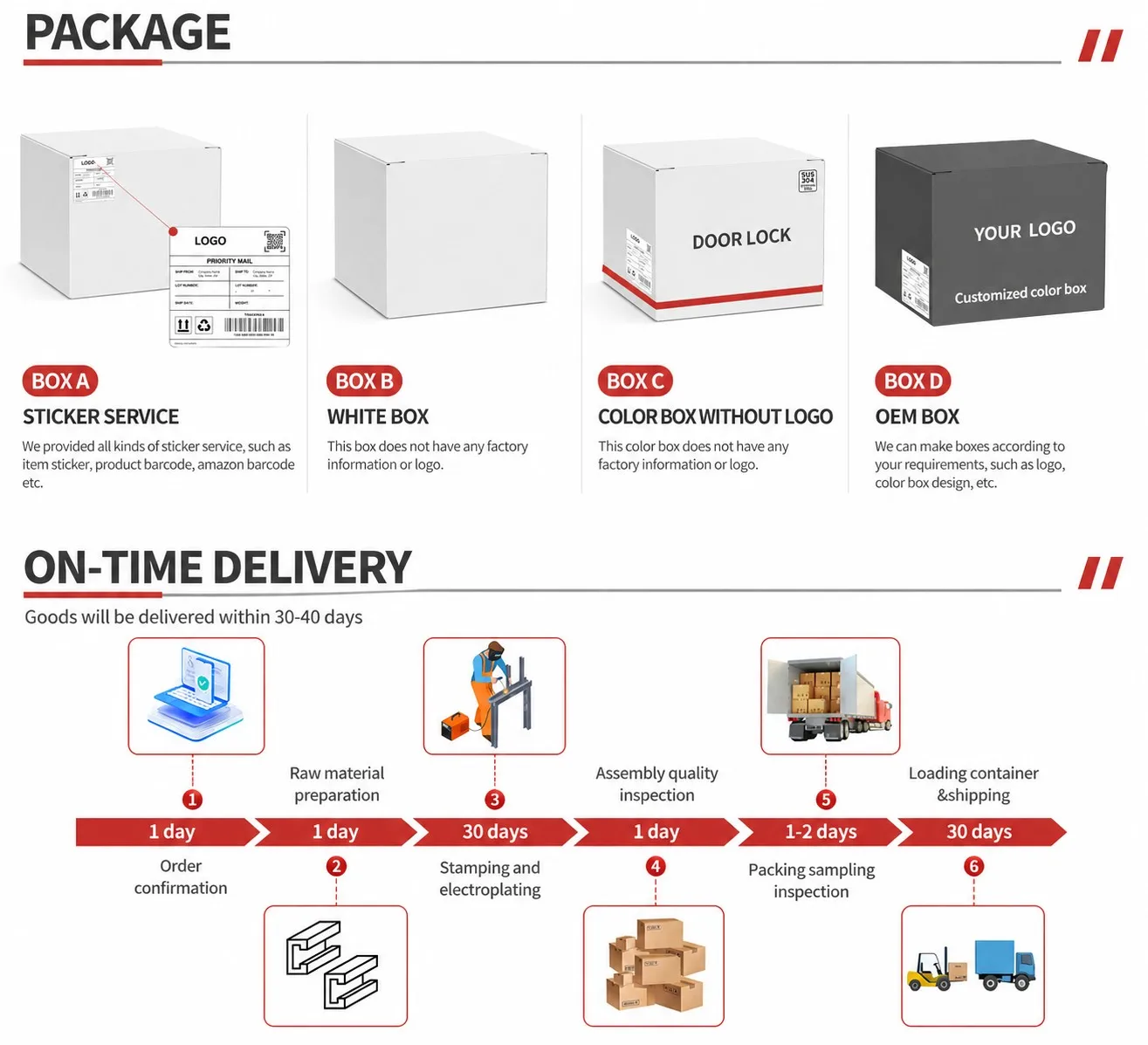



The G-JM19 bracket has 52 mm legs, a 40 mm face, four holes in each leg and a pressed rib along the fold, in yellow zinc, packed in banded bundles to a count.
Give the member width and the leg length you need, and the bracket can be checked against the joint before anything ships.


Comprehensive score